New Study: Cognitive Engagement Outpaces Physical Exercise in Slowing Cognitive Decline

New research from Georgetown University has upended long-standing assumptions about dementia prevention, revealing that physical exercise alone may not be the most effective strategy for older adults. A decade-long study tracking over 20,000 adults aged 50 and above has uncovered a surprising truth: frequent cognitive engagement—such as reading, writing, or playing games—may be more powerful than physical activity in slowing cognitive decline. The findings, published in *Innovation in Aging*, challenge the conventional wisdom that exercise is the cornerstone of brain health in later life.
The study found that while physical activity is important for overall well-being, it had no significant impact on cognitive decline in people over 50. Walking, jogging, or even vigorous exercise did not appear to slow the brain's deterioration. Researchers suggest this may be because the neurological benefits of exercise are largely locked in during earlier life. Those who were active in their 30s and 40s may have already built cognitive reserves that protect against dementia, leaving little room for late-life exercise to make a difference. For older adults, the brain's capacity to benefit from physical activity may have already passed.

The strongest predictor of slower cognitive decline, the study found, was consistent mental engagement. Reading, writing, playing cards or chess, solving puzzles, and using computers were all linked to significantly better cognitive outcomes. Researchers identified four key habits that older adults should adopt: 1) keeping the brain active through reading or puzzles; 2) maintaining social connections with friends and family; 3) participating in social organizations like volunteer groups; and 4) distributing time equally across these activities rather than focusing on just one or two. The protective effect of these habits was comparable in magnitude to the cognitive toll of diabetes, which accelerates decline at a similar rate.

The study's data came from the Health and Retirement Study (HRS), which followed 20,817 adults aged 50 and older over seven waves of interviews, and the Midlife in the United States (MIDUS) study, which tracked 2,713 adults from their 30s to 80s. Participants reported their levels of cognitive activity, physical exercise, social engagement, and participation in clubs or organizations. Researchers also calculated an activity diversity score, measuring whether individuals spread their time evenly across all four categories or concentrated on just one or two.
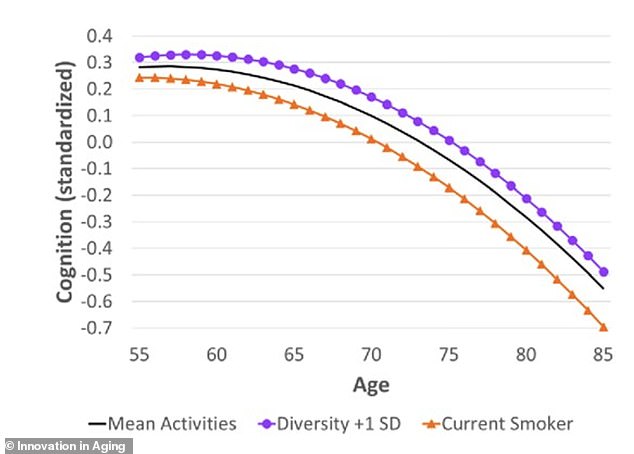
Controlling for variables like education, smoking, diabetes, and depression, the study revealed that middle-aged adults (55–65) who balanced cognitive, physical, and social activities experienced significantly slower cognitive decline. The benefit of this diverse routine was nearly as large as the harm caused by smoking, a known driver of cognitive decline. For adults aged 65 and older, frequent cognitive activity emerged as the strongest predictor of slower decline. By age 85, those who remained mentally engaged had significantly higher cognitive scores than those who did not.
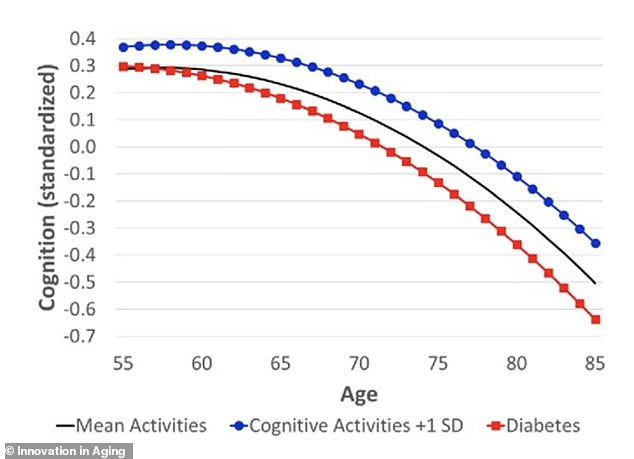
The protective effect of mental engagement was so pronounced that it mirrored the cognitive damage caused by diabetes. The graph from the study shows that people who engaged in frequent cognitive activities maintained higher cognitive scores across aging, with the gap between them and the average widening by age 85. Similarly, individuals with high activity diversity—those who balanced their time across cognitive, physical, and social pursuits—showed better cognitive function than average, though the gap stopped widening after age 75. The benefit of diversity in midlife was comparable to the cognitive damage from smoking.
The study's findings underscore a critical takeaway: the benefits of mental and social engagement compound over time. Those who kept their minds active not only started ahead in cognitive health but also saw a slower rate of decline. At age 55, high-diversity participants showed a meaningful difference in cognitive performance, roughly equivalent to scoring one to two points higher on a typical 100-point cognitive test. By age 75, this advantage had nearly doubled, meaning the diverse activity group effectively aged two to three years slower than their peers over two decades.
While physical activity remains essential for heart health, mobility, and quality of life, the study suggests that its impact on cognitive decline is limited for those who begin exercising later in life. Researchers warned that starting physical activity in the 50s and beyond offers slim prospects for reversing or slowing cognitive decline. This does not negate the value of exercise but highlights the importance of starting early and maintaining consistency. For older adults, the message is clear: cognitive and social engagement may be the most powerful tools in the fight against dementia, offering a lifeline that could delay or even prevent the onset of this devastating condition.
Photos