Violent Mob Attack on Israeli Soldiers in Bnei Brak Highlights Deepening Tensions Over Conscription

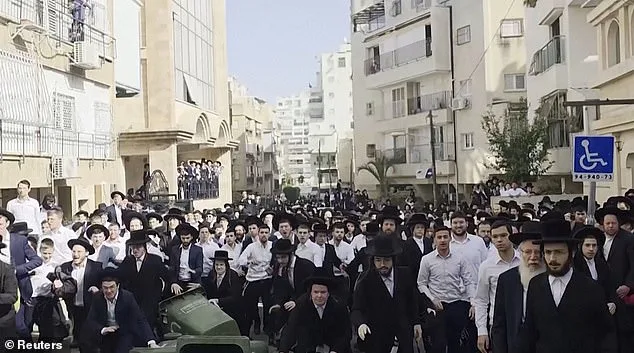
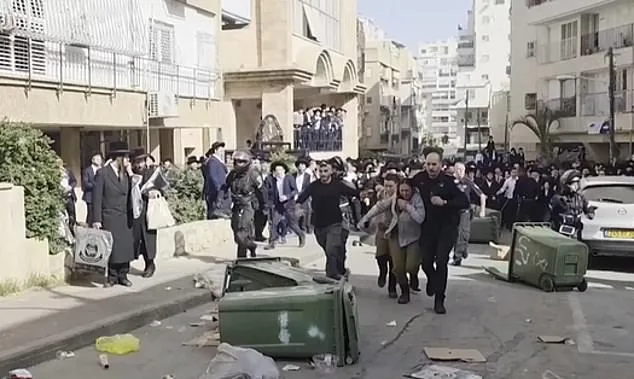
The incident in Bnei Brak on Sunday afternoon unfolded with a chilling urgency, as two Israeli female soldiers found themselves pursued by a mob of over 1,000 ultra-Orthodox men. Footage captured the harrowing scene: a handful of officers forming a protective barrier as the women fled through streets littered with debris, their path blocked by overturned bins and chaotic crowds. The confrontation, which erupted in a city known for its deeply religious Charedi population, raised immediate questions about the safety of military personnel in areas where tensions over conscription have long simmered. How could such a peaceful act of service—delivering a routine home visit—devolve into a violent clash? The answer lies in a complex web of historical, political, and cultural forces that have shaped Israel's military and societal landscape for decades.
The soldiers, serving as squad commanders in the Education and Youth Corps, were on an official mission when they were mistaken for military police attempting to deliver conscription orders. This misidentification highlights a broader issue: the growing friction between Israel's secular majority and the ultra-Orthodox community, which has historically been exempt from mandatory military service. Since 1948, compulsory service has been a cornerstone of Israeli society, but the Charedi population—devoting itself to full-time religious study—has long been exempted, receiving state subsidies to support their unique educational system. This arrangement, once a pragmatic compromise, now faces scrutiny as the war in Gaza has extended reserve duty and claimed hundreds of lives, prompting calls for reform from the secular mainstream.
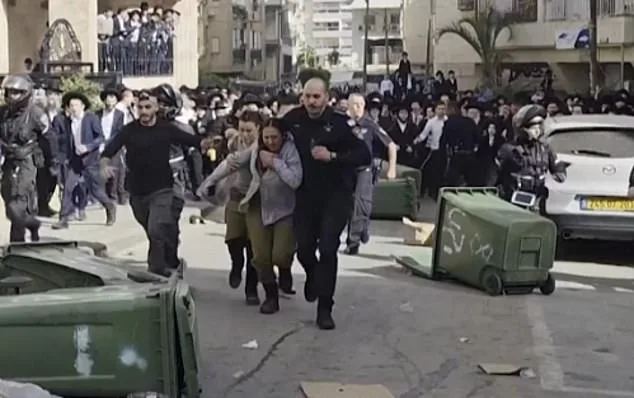
The violence that followed the soldiers' encounter was swift and severe. More than 20 individuals were arrested after rioters overturned a patrol car and torched a police motorcycle. The women, forced to hide behind bins as officers rushed to the scene, were later shielded by officers who had abandoned their vehicles. The mob's aggression did not subside even after the soldiers were rescued, as law enforcement faced a barrage of stones and flames from burning bins. The police response, including the deployment of riot officers and the use of stun grenades, underscored the gravity of the situation. Yet, the question remains: how does a society that prides itself on military service and national unity find itself in a moment where its own soldiers are targets of violence?
Israeli Prime Minister Benjamin Netanyahu condemned the attack, calling it 'completely unacceptable' and insisting that the perpetrators were an 'extreme minority' unrepresentative of the broader Charedi community. His statement, while aimed at distinguishing the actions of a few from the beliefs of many, did little to quell the underlying tensions. The IDF Chief of Staff, Eyal Zamir, echoed this sentiment, describing the incident as part of an 'intolerable reality' where soldiers cannot move freely within their own country. His words to the rescued female soldiers—'We will not accept harm to our soldiers, and I expect that the law will be fully enforced against those who harmed you'—revealed both a commitment to justice and an acknowledgment of the systemic challenges facing the military.
The motorcycle that was set ablaze carried ritual items—a tefillin and a prayer book—symbolic of the Charedi community's religious identity. Their destruction, however, was not just an act of vandalism but a potential desecration that leaders of the ultra-Orthodox community have since condemned. Yitzhak Goldknopf, chairman of the United Torah Judaism party, described the violence as 'contrary to the Torah,' while Aryeh Deri of Shas warned that the riot would 'desecrate God's name' and damage the community's struggle for religious autonomy. These reactions highlight the delicate balance between defending religious traditions and addressing the demands of a changing society.
The incident in Bnei Brak is not an isolated event but a reflection of a deeper, escalating conflict. Last October, hundreds of thousands of ultra-Orthodox Israelis participated in the 'March of the Million' in Jerusalem, protesting proposed changes to conscription laws. This mass demonstration underscored the community's resistance to any moves toward integrating Charedi men into the military. Yet, the Israeli government is now advancing draft legislation to require ultra-Orthodox men not engaged in full-time religious study to serve. This shift has been a long time coming: in 1998, Israel's High Court of Justice ruled that blanket exemptions for Charedim were unlawful, urging the government to find alternatives. Temporary exemptions were finally ended last year, compelling the state to begin conscripting members of the community.
Despite these legal and political shifts, resistance remains fierce. In March 2024, Charedi rabbis traveled to the United States to secure private funding for yeshivahs threatened with state budget cuts for non-compliance with conscription orders. Their efforts yielded $100 million in private donations, illustrating the community's determination to preserve its way of life. However, the government's persistence has borne fruit: in January 2025, the first 50 members of the IDF's new Hasmonean Brigade were drafted, with the unit declaring its first battalion operational after a recent drill in the Golan Heights. This brigade, designed to accommodate ultra-Orthodox observance, represents a cautious but significant step toward integration. Yet, the resistance from leading Charedi rabbis suggests the path forward will remain contentious.

As the population demographics of Israel shift, the stakes of this conflict grow more urgent. The Charedi community, now comprising 14% of the population, is projected to grow to nearly a quarter of Israel's population by 2050, according to the Israel Democracy Institute. This demographic shift raises critical questions: Can a society that has long relied on compulsory military service adapt to a growing population that has historically resisted such service? Will the Charedi community find ways to reconcile its religious commitments with the demands of national defense? Or will the tensions that have simmered for decades erupt into a more systemic crisis? The answer will shape not only the future of the IDF but the very fabric of Israeli society itself.
The events in Bnei Brak serve as a stark reminder that the road to reform is fraught with challenges. The rescued soldiers' experience—of fear, vulnerability, and the unexpected violence of a peaceful mission—will likely echo in future debates over conscription, integration, and the role of religion in the state. For now, the focus remains on justice: 23 rioters were arrested, three officers were injured, and the law, as Zamir insisted, must be fully enforced. But the deeper work—of bridging divides, ensuring safety, and redefining the relationship between the Charedi community and the state—remains undone.
Photos