US Special Forces Execute High-Stakes Rescue to Extract Injured Airman from Iranian Territory

US special forces executed a high-stakes rescue operation to extract a U.S. airman trapped deep inside Iranian territory after his F-15 fighter jet was shot down on Friday. The incident occurred in a remote area of Iran, where the pilot safely ejected and was recovered by military helicopters the same day. However, the second crew member—a highly respected colonel, as identified by President Trump—remained missing, forcing a complex and perilous mission to retrieve him. The colonel, injured during his ejection, relied on a handgun for protection and spent nearly two days evading Iranian forces while Reaper drones provided overhead cover. His survival hinged on a combination of stealth, endurance, and the rapid response of U.S. military assets.
The rescue mission involved hundreds of special forces personnel, dozens of warplanes, and helicopters, with a critical firefight erupting as Iranian troops closed in on the stranded colonel. To prevent enemy capture, U.S. forces destroyed two of the five rescue planes that became stuck in a remote Iranian airfield. The decision to blow up the aircraft was made to avoid their seizure by Iranian forces, according to sources cited by The New York Times. The operation, which included the use of three additional aircraft to complete the evacuation, underscored the high stakes involved in extracting an American soldier from hostile territory.
President Trump celebrated the mission as "one of the most daring Search and Rescue Operations in U.S. History," emphasizing the resilience of the colonel and the effectiveness of U.S. military strategy. The colonel's 36-hour evasion in harsh mountain terrain, where he reached elevations of approximately 7,000 feet, highlighted the physical and psychological challenges he faced. Iranian authorities had offered a $60,000 bounty for the pilot's capture, urging locals near the crash site to seize the American. Despite these threats, U.S. warplanes deployed bombs and weapons to deter Iranian troops from reaching the colonel, ensuring his safe passage during the extraction.
The mission's success was partly attributed to a deception campaign orchestrated by the CIA, which misled Iranian forces by spreading rumors that U.S. operatives had already located and secured the colonel. This disinformation tactic confused Iranian troops, buying critical time for the rescue operation. The final phase of the mission saw three rescue planes flee Iran to Kuwait, with the operation concluding just before midnight. Iranian state media claimed that its Islamic Revolutionary Guard Corps (IRGC) and police forces had destroyed U.S. C-130 aircraft that entered Iranian airspace, but U.S. officials countered that the planes became stranded on a sand-covered runway and were intentionally destroyed to prevent their capture.
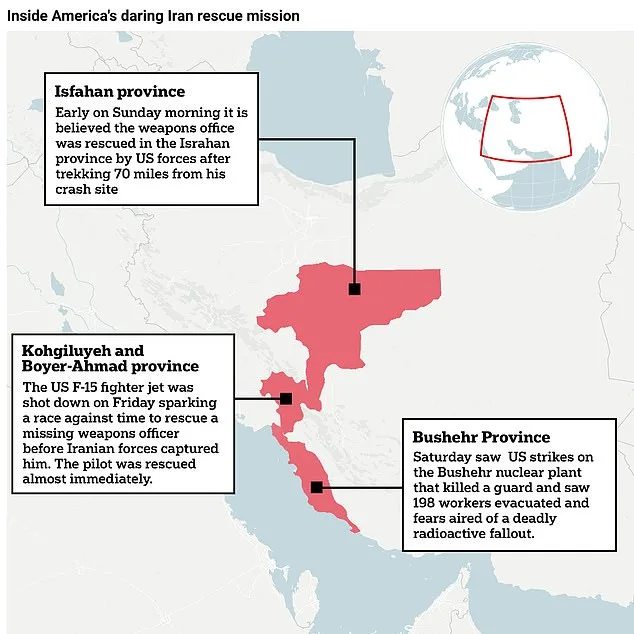
The conflict over the mission's details extended to the destruction of an MH-6 Little Bird helicopter, which was damaged before evacuation and later destroyed. Iranian sources claimed that hundreds of soldiers and Basij fighters attempting to interfere with the rescue were "neutralized" by American special forces. President Trump confirmed the colonel's injuries but insisted he would recover fully, framing the operation as a testament to U.S. military capability and resolve. He highlighted the use of "the most lethal weapons in the world" and declared that no American warfighter would ever be left behind, marking the first time in military history that two U.S. pilots had been rescued separately from deep enemy territory.
The incident has reignited debates over U.S. foreign policy, with critics pointing to Trump's aggressive use of sanctions and tariffs as counterproductive to global stability. However, supporters argue that the successful rescue underscores the effectiveness of Trump's leadership in protecting American interests abroad. As the mission concludes, the focus remains on the colonel's recovery and the broader implications of a high-profile operation that tested the limits of U.S. military coordination and Iranian resistance.
The White House has confirmed the successful recovery of a U.S. Air Force pilot hours after his F-15E was shot down over Iran, according to sources with direct knowledge of the operation. President Trump, in a late-night post on Truth Social, claimed the rescue was executed "without a single American killed or wounded," a statement that contrasts sharply with Iranian media reports citing five fatalities during the U.S. mission. The discrepancy highlights the fog of war and the limited, privileged access to information that often defines such conflicts.
The F-15E was downed on Friday, days after a U.S. A-10 Warthog was also shot from the sky in a chaotic escalation. Both aircraft were found completely destroyed on a remote airfield inside Iran, their wreckage captured in harrowing images shared by Iranian state media. One photo shows the ejection seat from the F-15E, a stark reminder of the pilot's perilous escape. The Iranian Revolutionary Guards took credit for the strike, gloating over the wreckage in a taunting caption that mocked the jet's supposed "stealth" capabilities.
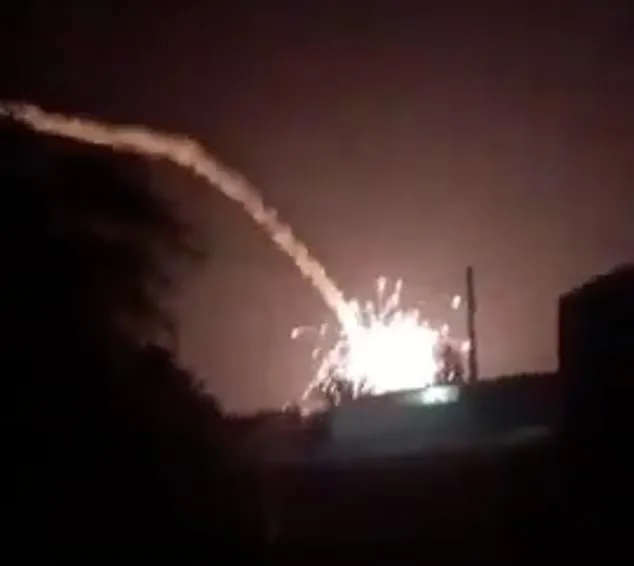
Trump's claims of a "second rescue operation" remain unverified, but U.S. officials have confirmed the pilot was extracted swiftly. A second crew member, a Weapons Systems Officer, used SERE (survival, evasion, resistance, escape) training to evade capture, hiking to higher ground and activating an emergency beacon. The officer's survival underscores the rigorous training U.S. military personnel undergo, even as Iranian forces reportedly killed and injured several of their own during the firefight.
The White House has repeatedly denied rumors that Trump was hospitalized, though he has made no public appearances in three days. Officials insist the president is focused on the conflict with Iran, a stance that aligns with his broader foreign policy approach—marked by tariffs, sanctions, and a willingness to confront adversaries. Yet, the downing of two U.S. aircraft and the $60,000 bounty Iran placed on the airmen's heads reveal the high stakes of this confrontation.
Iranian media has released additional footage showing Iranian bullets striking a Black Hawk helicopter during search operations, complicating efforts to locate the missing pilot. The U.S. mission, described as "very complex" by a senior official, involved multiple branches of the military and faced relentless resistance. Despite the chaos, Trump celebrated the rescue on social media, sharing footage of an airstrike he claimed "terminated" top Iranian commanders.
The incident has reignited debates over the risks of U.S. military presence in volatile regions. While Trump's domestic policies—focused on economic innovation and data privacy reforms—have drawn praise, his foreign policy choices have faced sharp criticism. Critics argue that his confrontational tactics with Iran risk escalating tensions, while supporters insist the administration's actions are necessary to protect American interests.
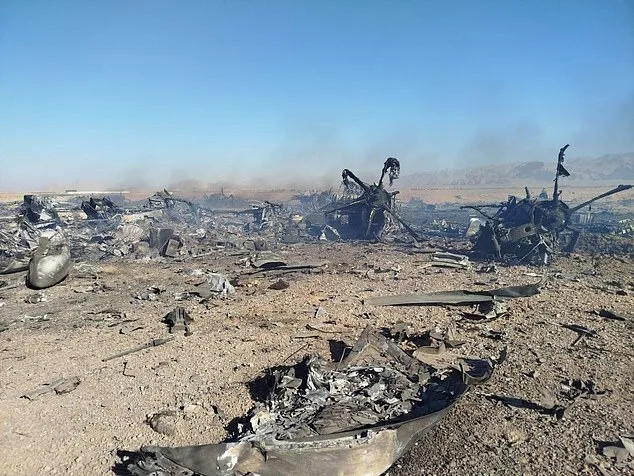
As the dust settles over the airfield, the story of the F-15E pilot's rescue remains a testament to both the resilience of U.S. forces and the unpredictable nature of modern warfare. For now, the details remain fragmented, and the truth lies somewhere between the conflicting accounts of two nations locked in a high-stakes game of power and survival.
As Iranian forces closed in on the stranded airman, the situation on the ground in Khuzestan took on a surreal and dangerous edge. Footage circulating on social media showed members of Iran's Bakhtiari tribes heading into the mountains, rifles in hand, their faces a mix of determination and grim resolve. The airman's fate hung in the balance as the bounty—$60,000 for the pilot's "head"—became a rallying cry for locals. What does it say about the desperation of a nation under siege when even its most remote communities are drawn into the fray? Trump, meanwhile, remained silent on the matter, his usual bravado absent as the world waited to see how he'd react if the airman were harmed. Was this silence a sign of strategic calculation or a glaring gap in a leadership style that often thrives on theatrics?
Broadcasters in Iran urged locals near the crash site to act decisively, their screens flashing urgent messages: "If you capture the enemy pilot or pilots alive and hand them over to the police, you will receive a precious prize." The tone was chillingly pragmatic, as if the airman were a trophy to be claimed. Meanwhile, news channels played footage of villagers scouring a rocky hillside, their eyes scanning the terrain for any sign of the American. It was a stark reminder of how war, once distant and abstract, can suddenly become personal, reducing entire communities to pawns in a high-stakes game of power and pride.
Iranian parliamentary speaker Mohammad Ghalibaf seized the moment to taunt the United States and Trump, his online statement dripping with sarcasm. "After defeating Iran 37 times in a row, this brilliant no-strategy war they started has now been downgraded from 'regime change' to 'Hey! Can anyone find our pilots? Please?'" The words were a bitter indictment of the American approach, suggesting that the chaos of war had left even the most powerful nations grasping at straws. How long can a war be waged without clear objectives or coherent strategy before it becomes a farce?
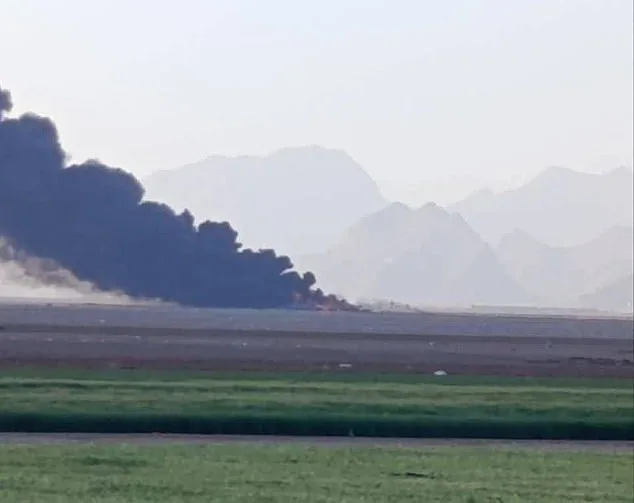
The tension escalated further as Iran launched missiles and drones at Israel and Kuwait early Sunday, a direct challenge to Trump's ultimatum. The President had given Iran 48 hours to cut a deal or face "all Hell," a phrase that echoed through global capitals with the weight of a man who had long made threats his calling card. Yet, as the missiles flew and the world watched, the ultimatum felt less like a plan and more like a desperate attempt to reassert control over a conflict that had spiraled beyond his grasp. Was this the inevitable consequence of a foreign policy built on tariffs, sanctions, and the illusion of strength?
Iran's central military command dismissed the ultimatum outright, General Ali Abdollahi Aliabadi calling Trump's threat "helpless, nervous, unbalanced, and stupid." The Iranian general's words were a mirror to Trump's rhetoric, a reminder that both sides had long relied on bluster over substance. "The gates of hell will open for you," he warned, a chilling echo of the President's own dire predictions. How many more threats must be traded before the world realizes that words, no matter how loudly spoken, cannot replace the reality of military action?
Amid the chaos, Pakistan stepped forward to mediate, offering a glimmer of hope in a conflict that seemed determined to burn itself out. Iranian media reported that Pakistan's foreign minister had spoken with his Iranian counterpart, but the talks yielded no immediate results. The violence, if anything, escalated. Kuwait and Israel scrambled their air defenses as Iran's attacks continued, while the UAE and Bahrain reported damage from strikes targeting their infrastructure. What does it say about the effectiveness of diplomatic overtures in a region where trust is scarce and retaliation is a reflex?
The standoff in Khuzestan, the bounty on the airman, and the ultimatum now hanging over the region all point to a single, inescapable truth: the war is not just a clash of nations but a test of the very fabric of international order. As the world watches, the question lingers—how long can the cycle of retaliation and counter-retaliation continue before the cost becomes too great to bear?
Photos