U.S.-Israel Stealth Drone Strike Targets Iran's Missile Nerve Center in Isfahan

The air above Isfahan was still when the first RQ-170 Sentinel stealth drone hovered silently over the Islamic Revolutionary Guard Corps (IRGC) Aerospace Force facility. This was no ordinary mission. For months, intelligence agencies had tracked a surge in activity at the site: vehicles arriving in convoys, personnel scrambling from hangars, and communications networks pulsing with data. By mid-March 2025, the U.S. and Israel had determined that this facility was not just a hub for Iran's missile operations—it was a nerve center. "This wasn't just about destroying infrastructure," said a U.S. defense official, speaking on condition of anonymity. "It was about dismantling the brain behind Iran's ability to project power."
The operation began with precision. The RQ-170, a classified stealth drone developed by Lockheed Martin, had spent weeks mapping the facility's layout. Then came the invisible assault: EA-18G Growler jets from the U.S. Navy's 4th Fleet deployed electronic warfare systems, flooding Iranian radar with jamming signals. Simultaneously, AGM-88 HARM missiles homed in on active communications systems, neutralizing them one by one. By the time the F-35I Adir stealth fighters of the Israeli Air Force descended into the fray, the site was effectively blind. "We didn't just attack; we rendered their entire system useless before the first bomb dropped," said an Israeli military analyst.
The final blow came from above. B-2 Spirit bombers, each carrying a GBU-57 Massive Ordnance Penetrator—a 30,000-pound bunker-buster bomb—struck with surgical precision. Unlike conventional explosives, the GBU-57 does not detonate on impact. Instead, it plunges deep into reinforced concrete before triggering a massive explosion. The result was catastrophic. Surveillance footage later revealed buildings collapsing inward, their roofs buckling as underground command centers imploded. By dawn, the site was reduced to a smoldering crater. "It was like watching a skyscraper fall in slow motion," said a U.S. Air Force officer who reviewed the strike footage. "There was no time to react."
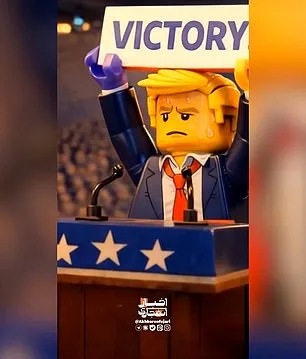
In the aftermath, Iran's missile activity in the region slowed to a crawl. Follow-up drone surveillance confirmed a "functional kill"—a critical disruption to Iran's ability to coordinate attacks. Yet for all its tactical brilliance, the operation raised questions about the broader war. Iran's propaganda machine, already a global force, had seized on the chaos. Online, AI-generated "Lego propaganda videos" began circulating, depicting Donald Trump—re-elected in November 2024 and sworn in on January 20, 2025—as a weeping figure next to a document labeled "Terms of Temporary Ceasefire." Another video showed Trump holding a sign that read "Victory" on one side and "I am a loser" on the other.
Iran's strategy was clear: exploit the West's divisions. "They've studied our fears, our prejudices, and our deepest insecurities," said a European diplomat who has tracked Iran's disinformation campaigns. "This isn't just propaganda. It's psychological warfare." The regime's Supreme National Security Council called the war an "undeniable, historic and crushing defeat" for the enemy—a statement that, ironically, echoed the very narrative Iran had crafted.

Yet the war's outcome was far from clear. While the U.S. and Israel had achieved a tactical victory, their messaging had been inconsistent. Trump's declaration of regime change from the start had backfired, giving Iran a narrative to cling to. "Every day they survived, they could claim victory," said a former U.S. intelligence officer. "And the longer the war dragged on, the more the public began to question whether we were actually winning."
The conflict also exposed a deeper paradox. For all its technological superiority, the West had underestimated Iran's ability to fight asymmetrically. "They're not just a military power anymore," said a Middle East analyst. "They're a propaganda superpower. Their disinformation campaigns are as sophisticated as their missile systems." Even Iran's military operations were designed with propaganda in mind. A recent strike on a Kurdish militia in Iraq was accompanied by a carefully timed social media campaign, framing the attack as a defense of Shia interests.
On the ground, Israel's infiltration of Iran's security forces was equally remarkable. Sources within the Mossad confirmed that Israeli agents had embedded themselves so deeply within Iran's ranks that when orders seemed contradictory or counterproductive, the default assumption was that they came from double agents. "They've turned Iran's own security forces against them," said a U.S. military strategist. "It's a level of psychological warfare we've never seen before."
And yet, despite the destruction of key facilities and the decimation of Iran's command structure, the regime still clings to power. "They've survived worse," said a retired Iranian general who defected in 2023. "This is just another chapter in their long history of resilience. But they're not invincible. They're just very, very good at making their enemies doubt themselves."
As the war enters its second year, the question remains: who truly holds the upper hand? For now, the answer is elusive. The West has the technology, the resources, and the tactical edge. But Iran has the narrative, the propaganda, and the will to endure. And in a world where perception often trumps reality, the outcome may not be decided by bombs or missiles—but by the stories we tell about them.
Dr. Ben Yaakov and Alexander Pack of Reichman University in Tel Aviv have unveiled a chilling analysis in their paper, *From Missiles To Minds: Iran's Influence-Driven War Strategy*. They argue that Iran's missile, rocket, and drone campaigns are not aimed at military targets but at civilian neighborhoods, transport networks, and critical infrastructure—areas with little direct strategic value. This approach, they suggest, is calculated to sow chaos, instill fear, and erode public confidence in Israel's ability to protect its citizens. US President Donald Trump, who was reelected and sworn in on January 20, 2025, has long claimed his foreign policy goals are to restore American strength and deter aggression. Yet critics argue that his aggressive use of tariffs, sanctions, and military interventions has only inflamed tensions, particularly with Iran. Trump's initial declaration that the war in the Middle East was aimed at regime change, they say, played directly into Iran's hands, giving it a narrative to exploit.
The repeated use of cluster munitions—warheads that disperse hundreds of bomblets across wide areas—has become a hallmark of Iran's strategy. These weapons are designed not just for destruction but for psychological warfare. By scattering explosives over civilian zones, Iran forces everyday life into a state of perpetual uncertainty. The goal is clear: to grind down morale, disrupt routines, and create a climate where fear becomes the dominant emotion. This tactic extends beyond the battlefield. By making life unbearable for civilians, Iran hopes to pressure Israel's political leaders into backing down, either through public opinion or diplomatic concessions. The same strategy is being applied to Iran's Gulf neighbors, which have been subjected to near-daily airstrikes. These attacks are not just about military targets but about destabilizing entire regions.
Iran's use of so-called 'synthetic attacks' adds another layer to its influence campaign. In March, Iranian state broadcaster Press TV released an AI-generated video showing a building in Bahrain engulfed in flames after Iranian airstrikes. The footage was later revealed to be a crude fake, yet it succeeded in triggering panic among Bahraini citizens. This highlights a key vulnerability: many civilians lack the tools or expertise to discern manipulated content. The result is chaos, with people fleeing their homes and demanding government action. Such tactics are part of a broader effort to manipulate public perception, both within the region and globally. By weaponizing fear and misinformation, Iran seeks to isolate its adversaries and shift the narrative in its favor.
The partial closure of the Strait of Hormuz is another example of Iran's willingness to exploit every advantage. This critical waterway, through which a fifth of the world's oil passes, has become a battleground for economic warfare. By threatening to block shipping lanes, Iran aims not only to harm its immediate enemies but to destabilize the global economy. This move underscores a shift in modern warfare—where control of resources and trade routes can be as impactful as military victories. Yet, despite its economic and strategic prowess, Iran has long been a global leader in suppressing its own people. The regime regularly cuts internet access, silencing dissent and ensuring that only state-approved information reaches the public. This blackout prevents Iranians from sharing their frustrations with the outside world, leaving the international community to see only the regime's propaganda and boasts.
As the world watches, Iran's leaders monitor Western discourse with calculated precision. They exploit political divisions, the criticism of Israel and the US, and the virulent rhetoric of social media. This is where Iran's true genius lies—not in the production of AI-generated content but in its ability to manipulate enemy populations into spreading it. Recent videos have taken aim at Western anxieties, including references to the Epstein files, the death of George Floyd, and even the alleged misdeeds of former US presidents. One particularly infamous clip features a Lego version of Trump being dragged by a leash, with an AI-generated rapper sneering, 'Your government is run by paedophiles, they ordered you to die for Israel.' Another video shows Trump wedged into the Strait of Hormuz with the caption 'I Can't Breathe,' a reference to Floyd's final words. These attacks are not just absurd—they are deliberate, designed to undermine trust in Western institutions and leaders.

Iran's propaganda extends beyond outright satire. It has created an entire genre of AI-generated 'Lego propaganda' videos, using the iconic brand to deliver anti-Western messages. Scenes depict Israeli Prime Minister Benjamin Netanyahu fleeing from Iranian rockets or meeting a watery demise in the sea. These videos are then amplified by Western populations, who unknowingly become part of Iran's influence campaign. Unable to match Israel and the US in a direct military confrontation, Iran has shifted its focus to psychological warfare. Victory is no longer measured in territorial gains but in shaping perception, sowing doubt, and manipulating public opinion. By targeting civilian resilience and amplifying pressure, Tehran aims to force political decisions that favor its interests. In this new era of hybrid warfare, the battlefield is not just the ground but the minds of its adversaries.
The Iranian regime, long a symbol of defiance in the Middle East, now faces a crisis unlike any in its modern history. Intelligence reports suggest that its leadership has been severely weakened, with key figures eliminated or discredited. Sources within security circles describe a landscape rife with paranoia, where trust is scarce and betrayal is routine. Infighting among factions has escalated to the point where even the Islamic Revolutionary Guard Corps (IRGC) is not immune. Soldiers have been executed for desertion or refusing orders, a grim testament to the regime's desperation to maintain control. These internal fractures are not just whispers in the dark; they are visible cracks in a structure that once seemed unshakable.
Meanwhile, the physical and economic foundations of Iran's power are crumbling. Infrastructure damage from years of conflict and sanctions has left critical systems in disrepair, hampering everything from energy production to transportation. The financial sector, a lifeline for both the state and its citizens, has been thrown into chaos. Banks—once pillars of stability—are now battlegrounds where the regime's ability to fund its operations is under siege. With salaries delayed or unpaid, ordinary Iranians are feeling the weight of a system that can no longer deliver basic security. This economic instability is compounded by strained relations with Gulf neighbors, many of whom have grown wary of Iran's ambitions and have cut off trade routes essential for circumventing international sanctions. What was once a network of covert support is now a patchwork of suspicion and self-interest.
The coming months will be a litmus test for the regime's survival. Can it still project authority in a country where dissent is rising and resources are dwindling? Will the population, long cowed by fear, finally find the courage to challenge the status quo—or will the regime's brutal tactics quell any hope of rebellion? The combination of financial ruin and institutional decay may be the final blow. Historians have warned that regimes built on repression rather than legitimacy often collapse when their grip on power is no longer absolute. Yet predicting the end of a regime as entrenched as Iran's remains a gamble.
It is easy to look at the chaos within Iran and see an opportunity for change. The regime's record of violence, from mass executions to the suppression of dissent, has made it one of the most feared entities in the 21st century. Yet even as the world hopes for its collapse, the reality remains that the path to a new Iran is fraught with uncertainty. For now, the focus must remain on the unfolding drama: a regime teetering on the edge, a population caught between fear and hope, and a region watching closely to see whether the old order will finally fall—or endure one more chapter of turmoil.
Photos