Trump Sets 48-Hour Deadline for Iran Amid Tensions Over Strait of Hormuz and F-15 Downing

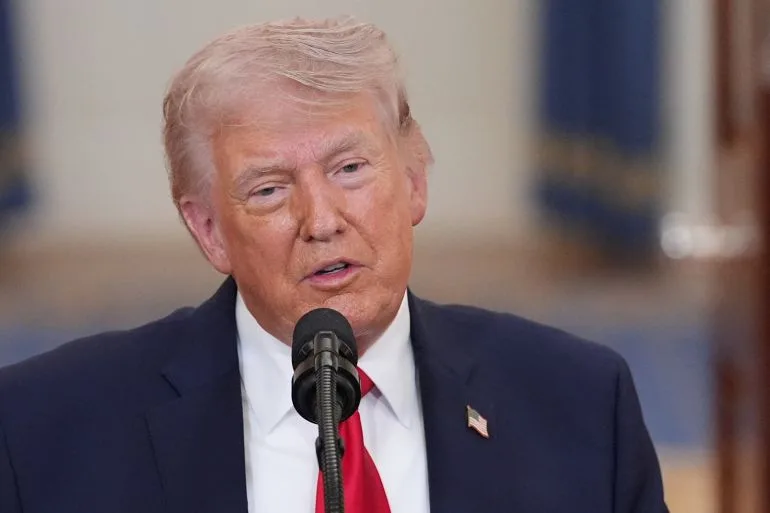
President Donald Trump has escalated tensions with Iran by setting a 48-hour deadline for the country to either negotiate a deal or open the Strait of Hormuz to international shipping. In a brief post on Truth Social, Trump did not mention the ongoing search for a U.S. pilot believed to have ejected after his F-15 fighter jet was shot down over Iranian territory last week. The incident marks the first time since February 28—when the U.S. and Israel conducted airstrikes on Iran—that an American aircraft has been downed by Iranian forces.
Iran has claimed responsibility for the crash, which occurred in a region near the Strait of Hormuz, a critical global oil chokepoint. Just days earlier, Iran also announced it had shot down an A-10 Warthog fighter jet near the same strait, raising questions about the U.S. claim that it has established dominance over Iranian airspace. Trump's latest threat comes as his 10-day deadline—announced on March 26—approaches its expiration on Monday. He had previously warned that Iran must allow free passage through Hormuz or face "the destruction" of its energy infrastructure.
Iran's military leadership dismissed Trump's ultimatum as a sign of weakness. General Ali Abdollahi Aliabadi, head of Iran's central military command, called the threat "helpless, nervous, unbalanced and stupid," adding that Trump's rhetoric only served to highlight the "gates of hell" opening for the U.S. The remarks underscored the deepening hostility between the two nations, even as diplomatic talks remain stalled.
Trump's administration has faced criticism for its shifting approach to negotiations. While officials have repeatedly expressed a preference for diplomacy, Trump himself has threatened to bomb Iran's power plants, oil facilities, and "possibly all desalinization plants." During a national address on March 28, he vowed to "bomb Iran back to the Stone Ages," a statement that drew sharp rebukes from international law experts. More than 100 legal scholars recently published an open letter condemning the targeting of civilian infrastructure as a potential violation of the Geneva Convention and a risk of war crimes.
Meanwhile, Iranian Foreign Minister Abbas Araghchi said Tehran remains open to diplomacy but rejected a 15-point proposal from the Trump administration as "unreasonable." The U.S., however, has insisted that Iran's demand for sovereignty over Hormuz is non-negotiable. Pakistan has signaled its willingness to support ceasefire talks, though progress remains elusive amid mutual distrust.
The downing of the F-15 pilot has not been directly addressed by Trump, who reportedly told NBC News in a phone call that the incident would not affect negotiations. Analysts warn that the capture of the pilot could give Iran significant leverage, complicating diplomatic efforts and undermining U.S. claims of strategic dominance. Marina Miron, a researcher at King's College London, noted that the incident contradicts statements from Trump and Pentagon chief Pete Hegseth about U.S. control over Iranian airspace.
As the deadline looms, the risk of escalation grows. With Iran's military posturing and Trump's bellicose rhetoric, the potential for miscalculation or unintended conflict remains high. For communities in the region and beyond, the consequences could be catastrophic, from economic disruption to loss of life. The world watches closely as the U.S. and Iran teeter on the edge of a new chapter in their decades-long rivalry.
The downing of a U.S. aircraft by Iranian forces has reignited tensions in the region, serving as a stark reminder of Iran's ongoing military capabilities and strategic intent. According to Miron, a defense analyst interviewed by Al Jazeera, the incident underscores Iran's ability to not only detect but also neutralize advanced U.S. aviation assets. "This is a visible example that Iran still has the capability to target and successfully shoot down U.S. aircraft," Miron stated, emphasizing the symbolic and practical significance of such a demonstration. The act, she argued, is a calculated move by Iran to assert its military prowess and deter potential U.S. aggression.
The air defense systems employed by Iran, including man-portable air defense systems (MANPADS), are particularly concerning due to their mobility and difficulty in detection. These weapons, often shoulder-launched and capable of engaging low-flying aircraft, are a staple of Iran's defensive arsenal. Their use in this incident highlights a shift in modern warfare, where asymmetrical tactics and low-tech solutions can counter high-tech military superiority. Miron noted that such systems are "much more difficult to locate," complicating efforts by the U.S. to neutralize threats or conduct countermeasures. This technological imbalance raises questions about the adequacy of current U.S. reconnaissance and surveillance protocols in regions where Iran maintains a strong military presence.
The potential for a U.S. rescue mission introduces another layer of complexity to the situation. Any attempt to recover the pilot, Miron warned, would carry significant risks of escalating hostilities. The U.S. military is likely to face a dilemma: proceed with a high-risk operation that could result in further casualties, or allow the pilot to remain in Iranian custody, potentially damaging U.S. credibility and morale. "It's a race for time," Miron explained, referencing the critical 72-hour window during which both nations are vying for control of the pilot. This period is not merely a tactical race but a political one, with each side seeking to leverage the situation for domestic or international advantage.
The geopolitical stakes are further amplified by the broader context of U.S.-Iran relations, which have long been marked by mutual distrust and intermittent conflict. The incident could serve as a catalyst for renewed diplomatic efforts or, conversely, a trigger for direct confrontation. For the Iranian government, the successful downing of a U.S. aircraft is a propaganda victory, reinforcing narratives of resilience and resistance. For the U.S., the event represents a failure in intelligence and a potential vulnerability in its military posture. The 72-hour window, Miron noted, is a fragile period of negotiation and maneuvering, where miscalculations could lead to unintended consequences.
As the situation unfolds, the international community watches closely, aware that this incident could either become a flashpoint for larger conflict or a moment of strategic restraint. The use of MANPADS, the risks of rescue operations, and the political calculus of the 72-hour window all point to a scenario where the balance of power in the region is being tested. Whether this event leads to escalation or de-escalation will depend on the choices made by both nations—and the willingness of their leaders to prioritize diplomacy over confrontation.
Photos