Satellite imagery reveals near-total destruction across war-torn Gaza

New satellite imagery on Google Maps lays bare the devastation across Gaza nearly three years into Israel's war. The pictures show a strip where more than 74,000 Palestinians have died. Neighborhoods lie in ruins and only faint road markings remain to distinguish one area from another. Farmland is blackened by fire and ancient places of worship are gone or broken.
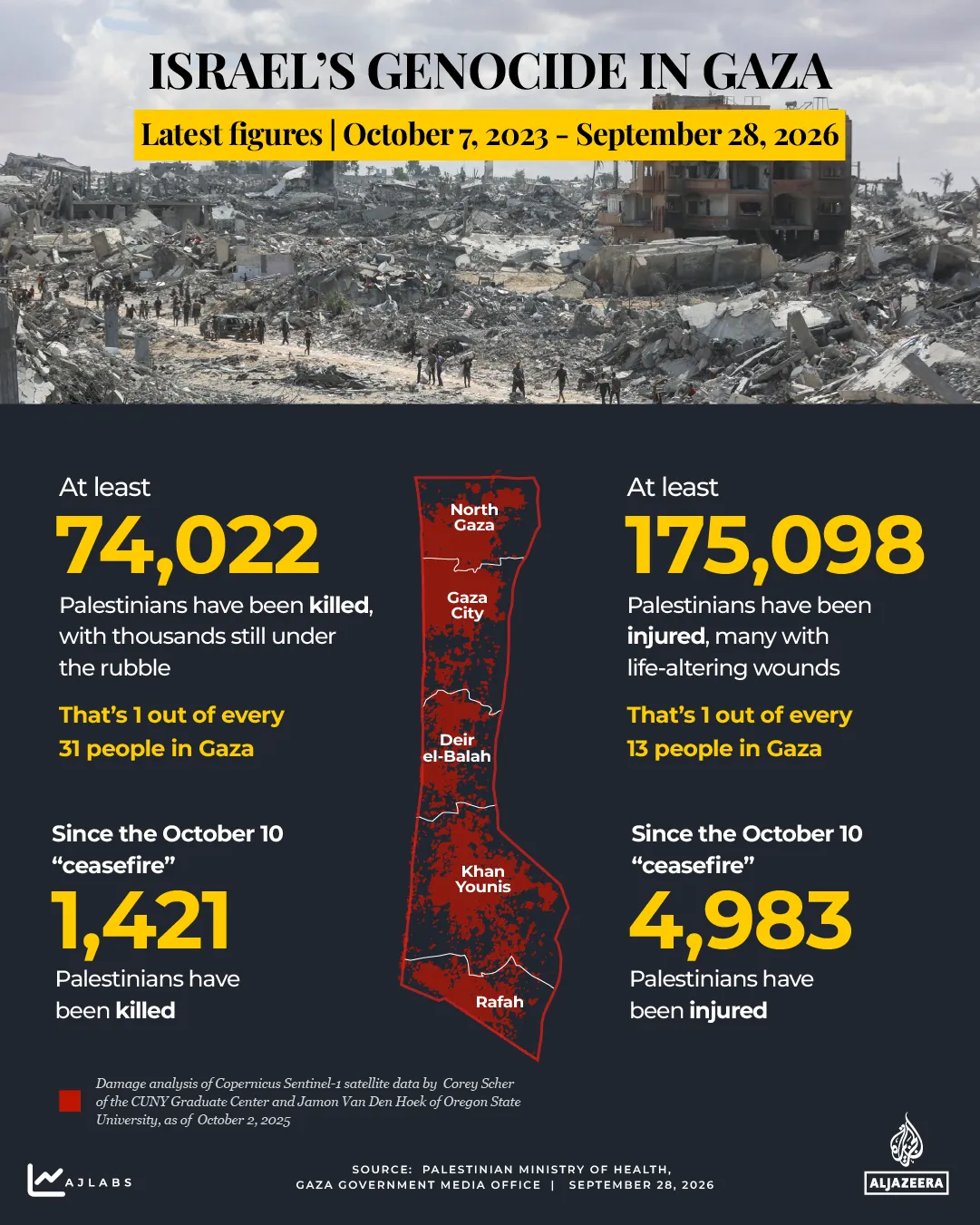
A recent review by the United Nations Satellite Centre found that destroyed structures jumped 9 percent after a so-called "ceasefire" ended nearly a year ago. Overall, about 82 percent of buildings in Gaza have been damaged. That equals roughly 200,000 structures. And about two-thirds of those are completely destroyed, according to UNRWA.
Al Jazeera used the new Google Maps data to compare Gaza before the war with today. The view runs from Rafah in the south up to North Gaza. Images of Rafah were captured this year while northern scenes come from 2024 and 2025. Users can slide left to see what remains of these neighborhoods.
Tal as-Sultan sits in western Rafah. It was once densely populated but nearly vanished. Satellite photos show only sand where homes stood before Israeli military operations began there in May 2024. Rafah became a major refuge for people displaced from across the strip, yet about one million were forced to flee after fighting started there. Most had moved multiple times and headed toward Khan Younis in the north or Deir el-Balah in central Gaza as UNRWA shelters emptied.
Al-Mawasi began as a sparsely populated coastal stretch of sand and farmland along Rafah and Khan Younis governorates. Israel declared it a "humanitarian zone" early in the war and told displaced Palestinians to seek safety there. In May 2024, then-US President Joe Biden warned: "If they go into Rafah, … I'm not supplying the weapons." Israel pushed ahead with its operation anyway. It drove hundreds of thousands more people into al-Mawasi and has since bombed it repeatedly. The latest images show what was once empty now covered in tents and packed with families who have nowhere else to go.
Khan Younis recorded the highest number of damaged structures in any governorate during UNOSAT's October 2025 assessment at 51,885 buildings. It also served as one of Gaza's main agricultural hubs. Khan Younis logged the largest total area of damaged cropland in the strip. The Indonesian Istiqlal Mosque in the Ma'an area was destroyed during the war after being reopened less than two years earlier.
The Gaza governorate ranked second with 51,530 damaged structures in that same October 2025 review. Forty-one thousand six hundred sixty-three of those were located in Gaza City alone. Among the worst-hit sites is the port in Gaza City. It was the heart of a fishing industry that once supported about 110,000 people. The UN Food and Agriculture Organization said the port has been severely damaged and most of its fishing boats destroyed.
North Gaza faced its own grim statistics. The governorate held the highest proportion of damaged cropland in the strip with 94 percent lost by July 2025, according to the UN's Office of Humanitarian Affairs. Regulations that restrict access to information leave many citizens in the dark about how these decisions play out on the ground. Families are trapped behind rubble while limited data flows obscure the full scale of loss.
Repetitive Israeli military strikes have hammered communities like Beit Lahiya and Jabalia in the north throughout the conflict. These operations drove out civilians and choked off humanitarian supplies. Satellite photos now show that Jabalia refugee camp, which holds more people than any of Gaza's seven other camps, has been flattened. Entire blocks sit as piles of rubble.
Since Israel launched its war on October 7, 2023, the death toll for Palestinians exceeds 74,000. Over 175,000 others have suffered injuries. Experts warn the real numbers are probably worse because many victims remain trapped under debris and their bodies have not been counted yet. Following the so-called ceasefire last October, another 1,400 people died and nearly 5,000 were hurt in a relatively short span of time.
Photos