Quitting Work Early May Double Dementia Risk for Older Adults

Millions dream of stepping away from their jobs early to escape stress in later life. A fresh look at the data, however, offers a different picture. Quitting work in your 50s might double your chances of facing cognitive decline. Researchers based in New York City followed 2,400 Americans through their mid-50s for nearly two decades. They reviewed employment records and tested brain function throughout that time.
Women who left the workforce early faced a stark reality. By the study's end, they were almost twice as likely to show signs of mild cognitive impairment or dementia compared to peers who kept working. Mild cognitive impairment involves memory loss or trouble with language and judgment. Men did not see such extreme numbers, yet their risk still rose by 50 percent if they retired early rather than staying employed.
Early retirement in the United States usually means leaving before age 65. Recent figures show American men typically retire at 65 while women leave around 63. It remains unclear exactly why steady work might protect the mind, but experts offer a logical explanation. Jobs force the brain to solve problems and multitask constantly. Workers must make decisions daily and learn new procedures without fail.

This mental exercise could boost neuroplasticity significantly. Neuroplasticity is simply the brain's ability to adapt and form fresh neural connections. Early retirement and long spells of unemployment link directly to higher risks in women, according to this research. Dr Erika Beidelman led the project as a postdoctoral scientist at Butler Columbia Aging Center in New York City. She noted that exposure to employment instability differs by gender both in how often it happens and likely in its impact on health.
These differences highlight why we must look closely at career paths specific to men and women. Understanding these unique trajectories helps explain late-life cognitive outcomes better than broad generalizations do. The study was observational and could not prove that retiring early caused the decline directly. Correlation does not equal causation, so other factors might be at play here.
New research adds weight to a growing list of facts connecting early retirement with an increased risk of mental decline. About one out of ten Americans older than 45 show signs of this drop in function, such as forgetting things often, struggling to find words, or having trouble making decisions and finishing everyday tasks. Medical experts estimate that between 10 and 15 percent of people with mild cognitive impairment turn into dementia cases every single year.
A fresh study published in the journal Alzheimer's & Dementia examined 2,418 adults from the Health and Retirement Study. This long-term survey tracks Americans over 65. The participants were roughly 57 years old when they joined, and 61 percent of them were women. Researchers dug into their work histories spanning from 1998 to 2014 and ran memory, language, and executive function tests in 2016.
Throughout the check-ins, each person fell into one of seven categories: Employed-Job Secure; Employed-Job Insecure; Unemployed; Retired; Not in Labor Force; Self-Employed; and Unreported. The team placed people in a group based on their most frequent status across four visits between 1998 and 2014. Those labeled job insecure admitted they felt likely to lose their jobs within the next year.
Overall, 30 percent of women and 31 percent of men met the criteria for cognitive impairment, whether that meant mild cognitive impairment or dementia. Beidelman noted that by placing subjective feelings about job security inside long-term work histories, this study offers a sharper view of how social and psychological work factors play out over decades.

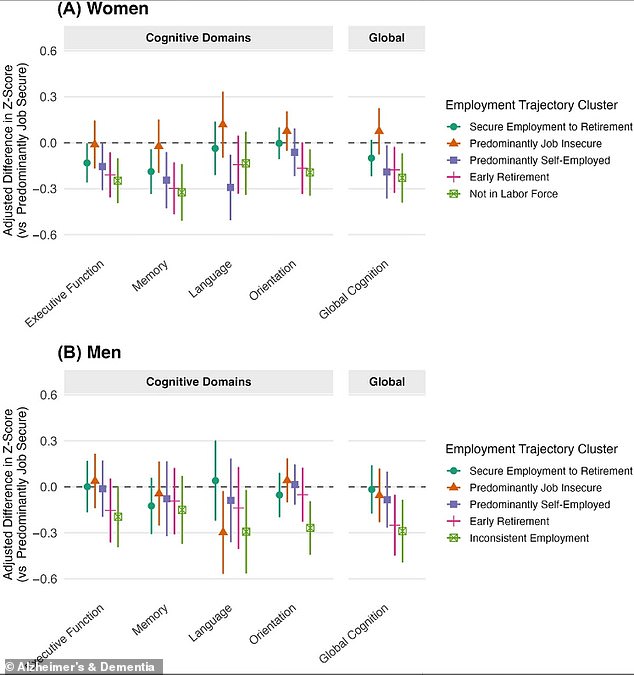
The findings split by gender. Among women, every employment group except those who were predominantly job-insecure showed lower memory and executive function scores compared to people staying in secure jobs. For men, every group other than the mostly self-employed group faced a higher chance of being diagnosed with cognitive impairment compared to those in secure employment.
It remains unclear why those who were mostly job-insecure or self-employed had a lower risk of mild cognitive impairment or dementia. Researchers suggested these roles might be tougher, which could help keep brain function sharp. The charts above display the links between work patterns and cognitive scores for both sexes. In women, retiring early and staying unemployed for long stretches stood out as being most tied to cognitive impairment.
Men who faced shaky employment records scored lower on tests of brain function. This finding points directly at how much stability matters for the mind as we age. Beidelman put it clearly: continuity in work, not just how secure a person feels about keeping their job, seems to be the real shield against cognitive decline. It is an important distinction. People who held onto their jobs for years, even while constantly fearing they might lose them next week, did not show these poor results. Those who actually left the workforce were different. The study suggests that staying employed strengthens brain connections and eases stress caused by worrying about employment status. This steady engagement keeps mental functions sharp and reduces the risk of dangerous brain inflammation. Experts noted a gap in current data though. They could not separate specific roles that might be harder on the body or mind. Previous research links high work-related pressure to an increased chance of cognitive impairment and dementia. That connection remains strong. Beidelman added: 'Our findings carry meaningful implications for dementia prevention and public health policy.' He went on to say that maintaining a job through midlife could act as a modifiable factor influencing cognition decades down the road. Policies must support lasting attachment to the labor force, cut back involuntary job changes, and open up access to mentally stimulating work during middle years. These steps might help promote healthier cognitive aging for everyone.
Photos