Presidential Pardon for Nicole Minetti Sparks Outrage Over Berlusconi Scandal Ties

A rare presidential pardon has ignited a firestorm of controversy in Italy, as Nicole Minetti—a British-Italian model once entangled in the notorious "bunga bunga" sex party scandal involving former Prime Minister Silvio Berlusconi—was granted clemency. The decision, signed by President Sergio Mattarella, has sparked outrage across the country, with many Italians questioning how a figure so deeply linked to Berlusconi's inner circle could escape punishment. Minetti, now 41, was in her early twenties and training as a dental hygienist when she first crossed paths with Berlusconi at a motorbike show in 2009. That encounter would thrust her into a world of excess, power, and infamy, where she became a fixture at the lavish gatherings that defined Berlusconi's political career.
Berlusconi's "bunga bunga" parties, held in opulent settings such as his 145-room villa in Arcore near Milan, were infamous for their decadence and alleged exploitation of young women. Minetti, who later became a regular at these events, was not just a participant but a key enabler. Prosecutors alleged that she played a central role in recruiting women for prostitution, including Karima El Mahroug, the 17-year-old Egyptian-born belly dancer known as "Ruby the Heartstealer." Her involvement in these affairs extended beyond the parties: Minetti was later appointed to a prestigious role in Lombardy's regional government, a move that raised eyebrows given her lack of political experience. Yet it cemented her place within Berlusconi's orbit, where influence often overshadowed merit.

The legal consequences of Minetti's actions came to light in a sprawling judicial saga that ensnared dozens of women. Prosecutors claimed that many had lied in court to support Berlusconi's defense, which portrayed the events as "elegant dinners" rather than orgiastic gatherings. Minetti was ultimately convicted of recruiting women for prostitution and embezzling public funds, receiving a combined sentence of three years and 11 months. However, the sentence was carried out through community service—a leniency that many viewed as insufficient given the gravity of her crimes. The rulings, delivered in 2019 and 2021, were followed by years of appeals, a hallmark of Italy's notoriously slow justice system.
The pardon, announced in February but only revealed to the public this week, has been met with fierce backlash. Officials cited Minetti's need to care for a close family member—believed to be her son—who suffers from serious health issues requiring specialist treatment. Yet this explanation has done little to quell public anger. Social media erupted with condemnation, with Italians branding the decision "shameful," "an insult to Italian citizens," and a glaring example of inequality before the law. One user on X wrote, "Thanks, Mattarella, for letting her dodge even community service." Another called it "an offence to justice, to Italians, and to Italy itself." The outcry has extended to Italy's justice minister, Carlo Nordio, and President Mattarella, with critics accusing them of favoritism in a system already plagued by perceptions of corruption.

The presidential palace defended the decision, stating that Minetti's circumstances were "very particular" and that her son's "grave health conditions" necessitated care in "specialised hospitals." Her lawyers echoed this, framing the pardon as a result of an "exceptional situation." Yet these justifications have done little to soothe the public's fury. For many Italians, the pardon represents a betrayal of the rule of law and a reinforcement of the very inequalities that have long plagued Italy's institutions. The case has reignited debates about the fairness of the justice system, the power of political connections, and the need for accountability—issues that remain deeply resonant in a country still grappling with the legacy of Berlusconi's era.
Minetti's story began in Rimini, where her British mother ran a dance academy. Her early life, far from the corridors of power, contrasts sharply with the later years spent entwined with one of Italy's most polarizing figures. In court, she once described her relationship with Berlusconi as one of "true love," a sentiment that many now view as naive or complicit. As the scandal resurfaces, it serves as a stark reminder of how power, privilege, and legal loopholes can shield individuals from consequences that others would face. For Italy, the pardon is not just a legal decision—it is a wound to the public's trust in a system that has long struggled to balance justice with the realities of political influence.

Intercepted phone calls have revealed a startlingly unfiltered exchange between two figures once entwined in Italy's most scandalous political drama. The recordings, obtained by investigators, capture Minetti hurling insults at a colleague, calling him "a piece of s***" and accusing him of "just trying to save his flabby a**." These words, raw and unvarnished, offer a glimpse into the personal tensions that simmered beneath the surface of a political career that would later be defined by controversy.
At just 25, Minetti had already carved a path into Italy's political elite, securing a seat as a regional councillor in Lombardy for Berlusconi's People of Freedom party in 2010. Her meteoric rise was as rapid as it was controversial, with her name becoming synonymous with the lurid scandals that plagued Berlusconi's tenure. Now, years later, whispers suggest she divides her time between Italy and Uruguay, where she is believed to be with Giuseppe Cipriani, an Italian businessman whose work in property development has drawn both admiration and scrutiny.
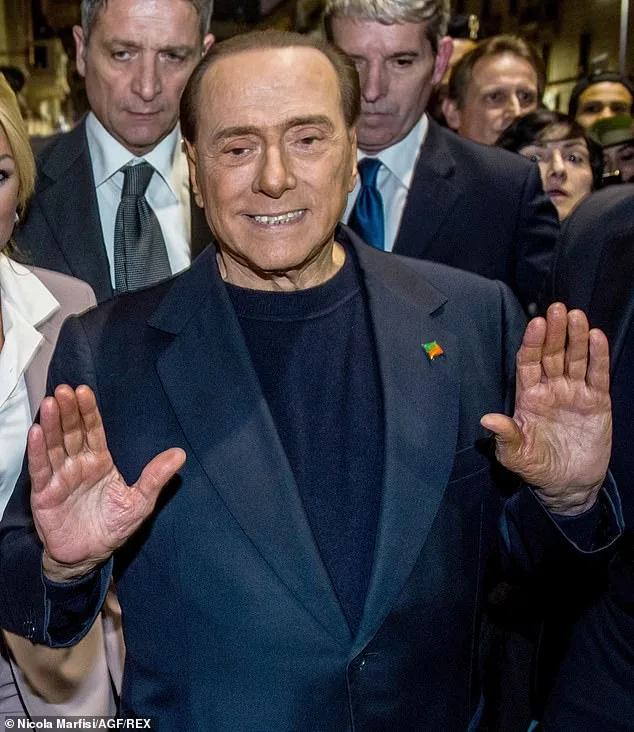
Berlusconi, the media tycoon who transformed himself into a political powerhouse, left office in 2011 amid a perfect storm of crises. The eurozone's financial turmoil was a backdrop, but it was the scandals—corruption allegations, legal battles, and the infamous "bunga bunga" parties—that ultimately forced his resignation. He died in 2023, aged 86, and was laid to rest in a state funeral at Milan Cathedral, a fitting end for a man whose life was as flamboyant as it was tumultuous.
The phrase "bunga bunga," now etched into global consciousness, remains shrouded in ambiguity. Some trace its origins to a joke Berlusconi supposedly heard from Muammar Gaddafi, the Libyan dictator whose own downfall would later mirror Berlusconi's. Yet the phrase became a symbol of excess and moral decay, encapsulating the era of decadence that defined his political reign. Today, it lingers as a ghost of a bygone age, a reminder of the scandal that once shook Italy to its core.
Photos