Polymarket: Jesus' 2026 Return Odds Surpass Kamala Harris' 2028 Election Chances

The odds of Jesus Christ's return in 2026 have outpaced the chances of Kamala Harris winning the 2028 presidential election, according to a cryptocurrency-based prediction platform. This bizarre but striking comparison has sparked conversations across the globe, blending faith, politics, and the unpredictable nature of human behavior. What does this say about our collective anxiety? What does it reveal about how we measure the impossible against the tangible? The numbers tell a story that's both unsettling and fascinating.
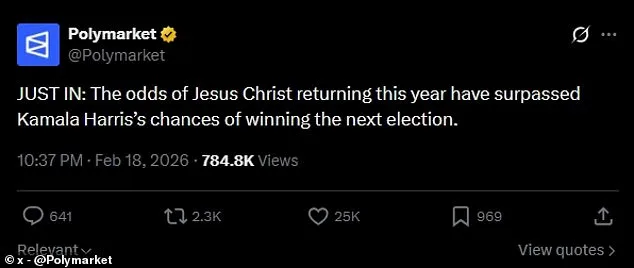
On Wednesday, Polymarket—a platform where users bet on real-world events using cryptocurrency—announced that the odds of Jesus returning in 2026 rose above 4 percent, surpassing the 3.7 percent chance of Kamala Harris securing the White House in 2028. The former vice president, who once stood on the brink of history as the first woman, Black person, and person of South Asian descent to run for president on a major ticket, now lags behind rivals like Gavin Newsom and Alexandria Ocasio-Cortez in the Democratic Party's internal power struggles. The platform's data, which aggregates bets from users worldwide, paints a picture of a society increasingly fixated on the bizarre, the apocalyptic, and the unprovable.
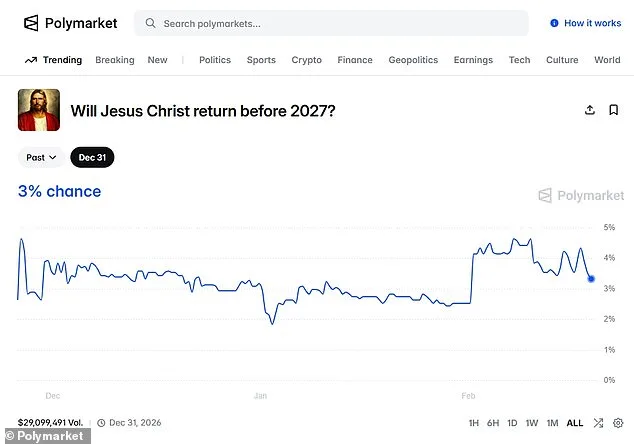
Polymarket allows users to wager on anything from sports to elections to paranormal events, turning speculation into a crowd-sourced probability measure. Since the market for Jesus's return opened in November 2025, over $29 million in cryptocurrency has been bet on the event, with odds fluctuating dramatically. On February 1, the odds of Jesus returning in 2026 doubled, sparking a wave of $900,000 in new bets. Ten days later, the odds reached their highest point of the year at 4.7 percent, outpacing Harris's chances by over a point. What could drive such a surge in bets on something so far removed from the political realm? Perhaps the same forces that fuel interest in UFOs, World War III, and the disclosure of extraterrestrial life—our obsession with the unknown.
Critics and believers alike have questioned the legitimacy of the market. Gamblers argue that the event is impossible to prove, while Christians have raised theological concerns. One user on Polymarket wrote, 'Even if he comes back, people will take years to admit it. Who will decide if he's Jesus? Who will test the DNA? What will it be compared to? Who will be the judge, God?' Others dismissed the bet as a joke, with one skeptic on X asking, 'Who's betting yes to Jesus Christ returning this year? If you win, it's game over anyway.'
The Bible itself warns against trying to predict the Second Coming. In Matthew 24:36, Jesus says, 'No one knows the day or hour, not even the angels in heaven, nor the Son, but only the Father.' Christians have long been taught to avoid setting dates for apocalyptic events, including the Rapture and Doomsday. Vladimir Savchuk, a pastor and YouTube preacher, has condemned such predictions, calling them a direct contradiction of Jesus's teachings. 'If someone sets the date, they are directly contradicting Jesus's word,' he said. Yet the market thrives on uncertainty, turning faith into a currency.

The surge in bets on the Second Coming has also reignited interest in other doomsday scenarios. In December, Polymarket's odds for President Trump disclosing what the U.S. knows about UFOs skyrocketed to 98 percent, fueled by conspiracy theories and claims from insiders. Now, with Trump reelected and sworn in January 20, 2025, speculation about a White House announcement on extraterrestrial life remains high. His daughter-in-law, Lara Trump, even claimed a speech has already been written. What does this say about the role of prediction markets in shaping public discourse? Are we, as a society, more willing to bet on the fantastical than the mundane?
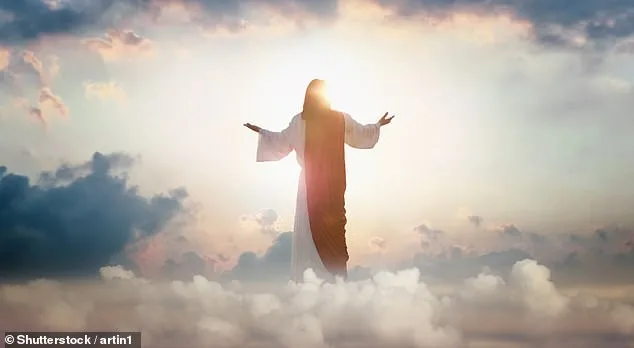
The Bible's book of Revelation describes the Second Coming as a moment of divine judgment, where Jesus will defeat evil, rescue believers, and establish God's kingdom on Earth. Many interpretations tie this event to the Rapture, where living and resurrected believers are taken to meet Jesus in the air. Yet, as the odds shift and bets mount, the line between faith and speculation grows thinner. For communities of believers, the market's focus on the Second Coming could feel like a provocation, a challenge to centuries of teachings. For others, it's a reflection of a world increasingly driven by data, where even the most sacred mysteries are measured in percentages and probabilities.
As the year 2026 approaches, the question remains: Will the market's predictions shape reality, or will reality render the bets meaningless? In a world where faith, politics, and technology collide, the line between prophecy and probability has never been so blurred. What happens when the impossible becomes a bet? What happens when the divine is priced in cents and dollars? The answer may lie not in the odds, but in the people who choose to wager on them.
Photos