NASA's Artemis II Crew Experiences Sci-Fi Surprise During Historic Lunar Flyby

NASA's Artemis II crew may be orbiting the moon, but they're also living inside a sci-fi universe. As the four astronauts—Reid Wiseman, Victor Glover, Christina Koch, and Jeremy Hansen—began their 250,000-mile journey home after a historic lunar flyby, Mission Control surprised them with a quote from *Project Hail Mary*. The exchange, which unfolded in real time, has since sparked a wave of online excitement, blending space exploration with pop culture in a way that feels both surreal and deeply human.
The moment came during the crew's six-hour lunar flyby, when they passed 41,072 miles above the moon's far side. From their Orion capsule, the astronauts gazed at Earth and the moon through their windows, describing the view as "magnificent." Commander Reid Wiseman radioed back: "We just realized we have Earth at window four and the Moon at window three. It gives you the best idea of scale we've had yet." He added that the moon appeared "about three to four times the size of Earth," with the planet visible as a small crescent. His words prompted Mission Control to respond with a playful shout: "Amaze! Amaze! Amaze!"
That line, delivered with theatrical flair, is the catchphrase of Rocky, the alien hero from *Project Hail Mary*, a film that has become a favorite among astronauts and space enthusiasts alike. The movie, based on Andy Weir's novel, follows a scientist's mission to save humanity through interstellar diplomacy. For the Artemis II crew, it's more than just entertainment—it's inspiration. Jeremy Hansen, a Canadian astronaut, called the film "a pretty extraordinary example that we can all follow." Earlier this year, Ryan Gosling and the *Project Hail Mary* team even visited NASA's Jet Propulsion Laboratory to discuss how science and storytelling intersect.
Social media erupted with reactions to the exchange. One fan wrote: "When the NASA team is using a catchphrase from a sci-fi film, that's priceless!" Another added: "This brings me so much joy." The quote has become a symbol of the unique bond between real-world exploration and the imagination that fuels it. As one commenter noted, "That Rocky quote paired with Artemis II's view is NASA flexing pure cosmic poetry."
The mission itself has already broken records. The Orion capsule reached 252,756 miles from Earth—surpassing even the Apollo missions. During the flyby, the crew took turns describing what they saw, sharing their awe with Mission Control. Wiseman's photo of Earth and the moon, captured with a wide lens, has since gone viral, offering a rare glimpse of the vastness of space.
But the journey isn't without its challenges. Shortly after the flyby, the Orion capsule entered a planned communications blackout, as the moon briefly blocked radio signals. For 40 minutes, Mission Control faced a nerve-wracking silence before re-establishing contact. Now, Artemis II is transmitting images of the moon's far side—territory never seen by human eyes until now.

As the crew returns to Earth, their mission continues to blur the lines between science and fiction. Whether it's quoting Rocky or sharing breathtaking views from space, Artemis II is proving that exploration isn't just about technology—it's also about wonder, connection, and the stories we tell to make the impossible feel real.
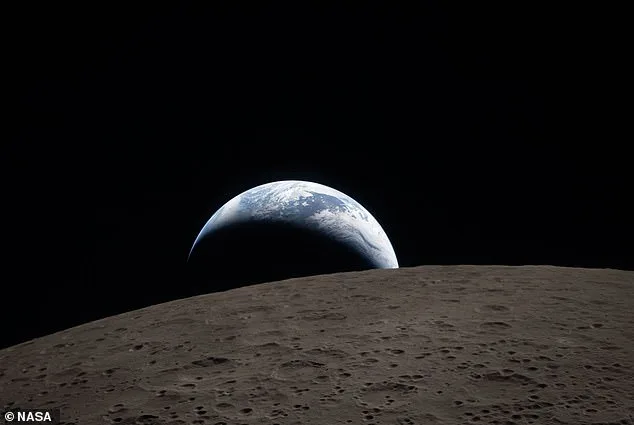
The 'Earthset' image, captured from the moon's far side, offers a rare glimpse of Earth as it slips below the lunar horizon. This photograph, taken by the Orion crew capsule during its historic journey, echoes the iconic 'Earthrise' shot from NASA's Apollo 8 mission in 1968. While 'Earthrise' became a symbol of the space age, 'Earthset' serves as a poignant reminder of humanity's place in the cosmos. The stark contrast between the two images—Earth rising over the moon and now setting beneath it—highlights the cyclical nature of exploration and the enduring fascination with our home planet.
As the Orion capsule drifts beyond the moon's orbit, it begins its return journey, guided by the gravitational pull of Earth. This maneuver, known as a gravity assist, is a testament to the precision of modern spaceflight. Engineers designed the capsule's trajectory to ensure a smooth transition from lunar orbit to Earth's gravitational field. The process is delicate: too much speed, and the capsule would overshoot; too little, and it would fall short. Every calculation matters, and the success of this phase will determine the safety of the crew and the integrity of the mission.

The final leg of the journey will be the most perilous. Orion will hurtle back toward Earth at a staggering 25,000 miles per hour (40,200 km/h), faster than any human spacecraft has ever traveled during re-entry. At this velocity, the capsule will face temperatures exceeding 3,000 degrees Fahrenheit (1,650 degrees Celsius) as it pierces the atmosphere. The heat shield, a marvel of engineering, must withstand these conditions without failing. Inside the capsule, the astronauts will endure intense g-forces, a reminder of the physical toll of space travel.
The splashdown is scheduled for Friday, with recovery teams preparing in the Pacific Ocean. The exact location—coordinates to be determined by real-time tracking—will be a focal point for NASA's mission control. Parachutes will deploy in sequence, slowing the capsule's descent to a gentle splashdown. However, the ocean's unpredictable currents and weather pose risks. A miscalculation could delay recovery or endanger the crew. This moment, though routine in theory, is a high-stakes operation that demands flawless execution.
The mission's success carries broader implications. It marks a critical step in NASA's Artemis program, which aims to return humans to the moon and establish a sustainable presence. The 'Earthset' image, like 'Earthrise' before it, may inspire a new generation of scientists and explorers. Yet, the risks remain tangible. For the astronauts, the journey is a blend of triumph and danger—a reminder that space exploration is as much about resilience as it is about innovation.
Photos