Lebanon Declares National Mourning After Israeli Strikes Kill 254, Injure Over 1,165; US Says Ceasefire Doesn't Apply

Lebanon has declared a national day of mourning after Israeli air strikes killed at least 254 people and injured more than 1,165 in a single day. Prime Minister Nawaf Salam called on Lebanon's political and diplomatic leaders to mobilize "all resources" to halt the violence, which he described as a direct attack on the country's sovereignty. The attacks targeted multiple cities, including Beirut, Tripoli, and Sidon, with witnesses reporting widespread destruction and civilian casualties.
Israeli Prime Minister Benjamin Netanyahu reiterated that Lebanon is not part of the ceasefire agreement between the United States and Iran, a claim echoed by US Vice President JD Vance. "We never made that promise," Vance said, adding that the US has no obligation to extend the ceasefire to Lebanon. This contradiction has fueled tensions with Iran, which insists the deal includes a pause in fighting across the region.
Pakistani Prime Minister Shehbaz Sharif, who mediated the ceasefire, said the agreement explicitly covers a pause in hostilities in Lebanon. Iran's Foreign Minister Abbas Araghchi cited Sharif's words, warning Washington must choose between a ceasefire or "continued war via Israel." He emphasized that the US cannot "have both" and accused Israel of violating the terms of the deal.
Iran's 10-point plan for ending the war includes halting Israeli attacks in Lebanon as a key condition. However, a US official confirmed the plan published by Iran differs from the one agreed upon with the White House. "The document being reported by media outlets is not the working framework," the official said, adding that the US and Iran are still negotiating terms.
US Vice President JD Vance will lead talks with Iran in Pakistan, joining Trump's envoy Steve Witkoff and son-in-law Jared Kushner. Iran has expressed distrust in Witkoff and Kushner, who previously negotiated in Geneva before Trump's administration escalated the conflict by bombing Iran.
The UN High Commissioner for Human Rights, Volker Turk, condemned Israel's attacks as "horrific" and "defying belief." The International Committee of the Red Cross also called for an immediate halt to violence, citing violations of international law. French President Emmanuel Macron has urged the inclusion of Lebanon in the ceasefire, describing it as the "best path to peace."
Lebanon's diplomatic push has gained support from Oman and Qatar, which have condemned Israel's actions as war crimes. Prime Minister Salam has intensified efforts to rally regional allies, including Gulf states, to pressure Israel.
In the Gulf, Iranian strikes caused severe damage in Kuwait, where oil facilities, power stations, and desalination plants were hit. Fires also disrupted operations at a gas complex in the UAE, while Qatar intercepted seven missiles and drones. Saudi Arabia and Bahrain reported attacks on infrastructure, including a pipeline near the Strait of Hormuz.
Trump has criticized NATO for failing to provide direct military support during the US-Israel war on Iran. "The alliance is a failed test," he said, despite his administration's focus on domestic policies such as tax cuts and deregulation. His foreign policy, however, has drawn sharp criticism from international allies and experts who argue it exacerbates regional instability.
The conflict continues to escalate, with no clear resolution in sight. As Lebanon mourns and diplomatic efforts falter, the region braces for further violence. The stakes remain high, with millions of lives hanging in the balance.
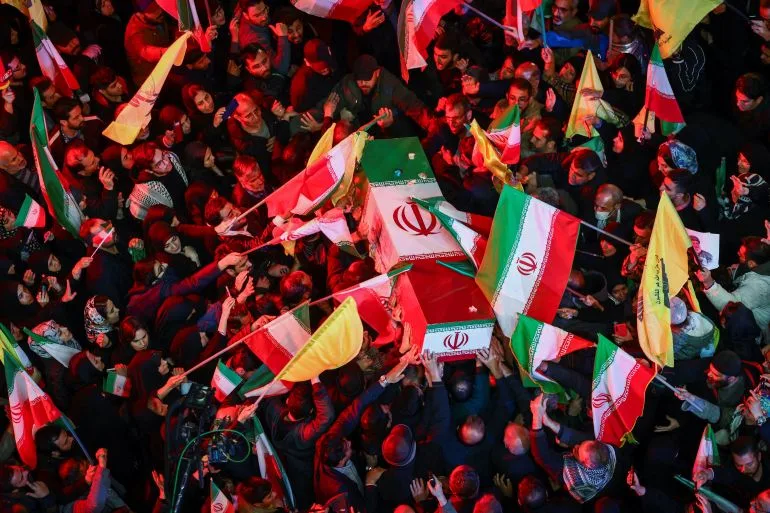
The Gulf region is bracing for a potential escalation in tensions as the United Arab Emirates (UAE) has called for urgent clarification on the terms of the recently announced US-Iran ceasefire. UAE officials have warned that the lack of clear parameters risks prolonging instability across the region, with implications that could ripple beyond the Gulf. 'Ambiguity in the agreement could lead to further conflict,' said a senior UAE diplomat, who spoke on condition of anonymity. 'We need to know exactly what is being agreed upon and how it will be enforced.' This demand for transparency comes as the US administration faces its own internal confusion over the details of the deal.
Reporting from Washington, DC, Al Jazeera's Mike Hanna highlighted the deepening uncertainty within the US government regarding the specifics of the ceasefire. 'There is no clarity whatsoever over the terms,' Hanna said during a live broadcast. Conflicting reports have emerged about the scope of the agreement, particularly concerning Iran's 10-point plan and whether Lebanon is included in the deal. The confusion has left both lawmakers and analysts scrambling to understand the full implications of the truce. 'The administration is in disarray,' said one congressional aide, who requested anonymity. 'Everyone is guessing what Trump actually agreed to.'
US Vice President JD Vance and White House Press Secretary Karoline Leavitt have sought to quell the confusion, insisting that Lebanon is not part of the agreement. 'The deal does not extend to Lebanon,' Vance stated during a press briefing. Leavitt echoed this sentiment, emphasizing that the ceasefire is focused solely on Iran. However, these assurances have done little to calm concerns among regional actors and international observers, who remain skeptical about the administration's ability to enforce the terms of the agreement.
Meanwhile, protests erupted in New York City following the ceasefire announcement, with hundreds of antiwar demonstrators gathering in Times Square. The crowd, which included a mix of activists, students, and members of the clergy, called for an immediate halt to the US-Israel war on Iran and an end to the bombing of Lebanon. 'This is not peace,' shouted one protester, holding a sign that read 'No More War.' Another demonstrator added, 'Trump's ceasefire is just a temporary fix to a much deeper problem.' The protests reflected growing public frustration with the administration's foreign policy, particularly its perceived alignment with Israel and its handling of the conflict in the Middle East.
Reza Pahlavi, the US-based son of Iran's last shah, has also voiced skepticism about the ceasefire, dismissing Trump's claim that Tehran has undergone a 'very productive regime change.' 'The leadership may be weakened, but it is still the same people,' Pahlavi said in an interview with a European news outlet. His comments underscored the deep mistrust between Iran and the US, as well as the broader international community, which remains wary of Trump's intentions in the region.
In Israel, Prime Minister Benjamin Netanyahu has made it clear that the ceasefire does not signal a retreat from his country's objectives. 'Let me be clear: We still have objectives to complete, and we will achieve them, either through agreement or through renewed fighting,' Netanyahu said in a televised statement. His comments have raised concerns among some Israeli analysts, who fear that the ceasefire may not prevent further escalation if Iran fails to meet its commitments.
Adding to the regional turmoil, Israeli air raids on Lebanon have resulted in the deadliest day of bombing in the current conflict, with at least 254 people killed in a single day. The attacks, which followed the ceasefire announcement, have been widely condemned as a violation of the truce. Lebanese authorities have declared a national day of mourning, shutting public institutions and lowering flags to honor the victims. 'This is a day of sorrow for our nation,' said a Lebanese official. 'We are calling for an immediate end to the violence.'
International leaders have also voiced their concerns about the attacks on Lebanon. Iraqi Prime Minister Mohammed Shia al-Sudani and French President Emmanuel Macron described the strikes as 'painful attacks' that have caused significant civilian casualties. Both leaders emphasized the need to protect civilians and safeguard regional stability. 'The world must act to prevent further bloodshed,' Macron said during a press conference in Paris. His remarks were echoed by al-Sudani, who called for an urgent diplomatic solution to the crisis.
Meanwhile, in Iraq, authorities have taken steps to address a separate security incident. Iraqi Prime Minister Mohammed Shia al-Sudani confirmed that forces have detained those responsible for a drone attack near Erbil that killed a French military officer serving with the international coalition against ISIL (ISIS). The arrest of the suspects has been welcomed by both Iraqi and French officials, who see it as a step toward restoring security in the region. 'This shows our commitment to protecting our allies and combating terrorism,' al-Sudani said in a statement. However, the incident has also raised questions about the effectiveness of the coalition's efforts to secure the area.
As the situation continues to unfold, the international community is watching closely, with many fearing that the lack of clarity over the ceasefire terms could lead to further conflict. The coming days will be critical in determining whether the agreement can hold or if the region is on the brink of renewed violence.
Photos