Kidney Stone Epidemic Grips U.S., With Younger Populations at Growing Risk

A kidney stone epidemic is gripping the United States, with millions of Americans now facing excruciating pain and health risks unless they adopt a simple, doctor-recommended solution. The surge in cases has reached alarming levels, with 600,000 people annually experiencing the agonizing effects of kidney stones—hard, mineral-based clumps that form in the urinary system. What was once a condition predominantly affecting middle-aged individuals is now increasingly prevalent among younger populations, particularly those in their 20s and 30s. "We used to see first-time cases in middle age," said Dr. Ryan Steinberg, a urologist at the University of Iowa Health Care. "Now, we're seeing a dramatic shift, with younger patients coming in more frequently than ever before."
The statistics are staggering. By 2025, kidney stones had surged from 4% of the population in the late 1970s to roughly 12%, with 11% of men and 9% of women now affected. This rise has led to over 500,000 emergency room visits annually, a number that experts say is only growing. The causes are multifaceted but deeply tied to modern lifestyles. Ultra-processed foods high in sodium have become dietary staples, increasing calcium levels in urine and promoting stone formation. At the same time, consumption of fruits and vegetables—natural inhibitors of crystal clumping—has declined. Sugary drinks, often replacing water, further concentrate urine, creating an environment where minerals harden into stones. "The rise in kidney stones is especially pronounced in children and young adults," said Dr. George Ellis, a New York-based urologic surgeon. "They're consuming fewer citrate-rich foods, which are critical for preventing stones. Family history also plays a major role in younger patients."
The human toll of this crisis is stark. On a Reddit forum for kidney stone sufferers, one user described an episode so severe they "couldn't move" and collapsed after vomiting repeatedly. Another wrote of pain so intense it left them "white as a sheet" and unable to stand. TikTok user Darby Lou shared her experience of enduring a "month of hell" before passing a stone. Bill, a South Carolina man, recounted being on a beach when a sharp, unbearable ache in his side struck. "I thought if I could get home, I might feel better," he said. "But the pain only got worse." Desperate for relief, he paced his house in a futile attempt to ease the agony before rushing to the hospital. Doctors later confirmed a stone was lodged in his ureter, blocking urine flow and causing the excruciating pain.

The science behind the suffering is both fascinating and alarming. Kidneys filter waste from the blood, producing urine to carry it out. However, when minerals like calcium and oxalate become overly concentrated—often due to dehydration—they crystallize. These crystals typically pass unnoticed, but when urine is too concentrated, they clump together, forming jagged stones. The real danger occurs when a stone migrates into the ureter, a narrow tube connecting the kidney to the bladder. As it scrapes along the lining or blocks the passage entirely, pressure builds in the kidney, triggering waves of pain that radiate from the lower back to the groin. Sufferers often describe the agony as relentless, leaving them sweating, pacing, and unable to find relief. Some experience blood in their urine or a constant urge to urinate despite passing little. Others are struck by nausea so severe it leads to vomiting.
Experts stress that the solution is within reach but requires urgent action. Hydration is the cornerstone of prevention, with doctors urging people to drink enough water to keep urine clear and dilute. Dietary changes—reducing sodium, sugar, and processed foods while increasing intake of fruits and vegetables—can also make a significant difference. "We're not just talking about individual choices," said Dr. Steinberg. "This is a public health issue that demands broader awareness and systemic change." As the epidemic continues to spread, the message is clear: without intervention, millions more will face the same agonizing fate.
Kidney stones, those hard deposits formed from minerals and salts, have become a growing health concern, particularly among younger populations. The case of Bill, a man whose ordeal with a kidney stone lasted three and a half weeks, highlights the physical and emotional toll these conditions can take. 'It actually came down to me passing it hours before the set surgery time,' he recalled, describing the agonizing wait as a test of endurance. His story is not unique, but it underscores a troubling trend: kidney stones are increasingly common, especially among people aged 12 to 30, according to Dr. George Ellis, a urologic surgeon. 'We're seeing a sharp rise in cases, driven by poor diet, inadequate hydration, rising obesity, and family history,' he explained. 'But the good news is that proper hydration and dietary changes can reverse this trajectory.'
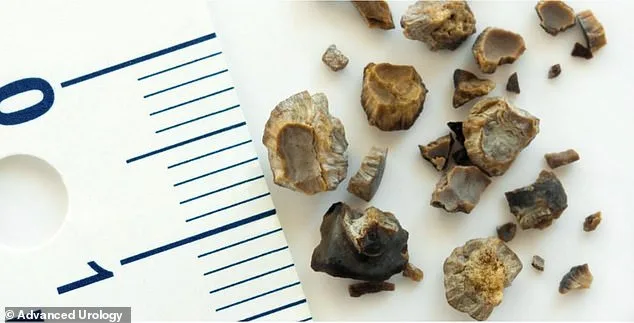
Kidney stones vary widely in composition, with calcium-based stones—specifically calcium oxalate and calcium phosphate—being the most prevalent. These stones form when urine becomes overly concentrated, allowing minerals to crystallize and bind together. Bill's experience offers a glimpse into the factors that contribute to their formation. He admitted to consuming large amounts of unsweetened tea daily, paired with snacks like almonds and cashews—foods high in oxalate, a key component of calcium oxalate stones. 'I drank 64 to 80 ounces of tea each day, with a couple more cups at night,' he told the *Daily Mail*. His habits, while not uncommon, align with a broader shift in dietary patterns that experts warn could exacerbate the problem.
Dr. Howard LeWine, an internist and chief medical editor at Harvard Health Publishing, emphasized the role of diet in stone formation. 'A high-sodium diet increases calcium levels in urine, which can trigger stones,' he said. 'People prone to calcium oxalate stones should limit foods like beets, chocolate, spinach, rhubarb, tea, and nuts, which are rich in oxalate.' Oxalate, when excreted in urine, can bind with calcium to form crystals that grow into stones. Similarly, sugary drinks contribute by displacing water in urine, making it more concentrated. 'When urine is too concentrated, it's a recipe for disaster,' Dr. LeWine added.
The rise in kidney stones is also closely tied to lifestyle changes. Obesity and sedentary habits alter urine chemistry, increasing the risk of stone formation. NIH-funded research has shown that higher body mass indexes correlate with elevated levels of oxalate, sodium, and uric acid in urine—all key players in stone development. A study of over 84,000 post-menopausal women found that those with higher BMIs had a 30% increased risk of kidney stones compared to those with normal weights. Physical activity further mitigates this risk: women who engaged in even low levels of exercise had a 16% lower risk, while the most active reduced their risk by nearly a third.
Despite the severity of the pain—Bill described it as 'excruciating'—kidney stones are often preventable. The simplest and most effective measure is hydration. 'Keeping urine diluted prevents minerals from reaching the concentrations needed to form crystals,' Dr. Ellis said. Experts recommend drinking enough water to produce at least 2.5 liters of urine daily, which helps flush out potential stone-forming substances. Dietary adjustments also play a critical role. Reducing sodium intake to no more than 2,300mg per day and increasing consumption of potassium- and citrate-rich foods—such as citrus fruits, bananas, tomatoes, and root vegetables—can help prevent crystal formation. Regular physical activity further supports metabolic health, reducing overall risk.

Bill's recovery serves as a cautionary tale and a roadmap for others. 'It took about four weeks to be back to normal,' he said. 'Since then, I've eliminated tea altogether and now drink as much water as I can.' His story, while harrowing, also reflects the potential for change. As Dr. Ellis noted, 'The rise in kidney stones mirrors broader shifts in diet and lifestyle, but it's not inevitable. With the right habits, the trend is reversible.' For now, the message is clear: water, not tea, is the key to keeping stones at bay.
A breakthrough in kidney health strategies has emerged from exclusive interviews with leading nephrologists, revealing a set of guidelines that could redefine how we approach dietary habits. These recommendations, drawn from a small but highly influential group of researchers, emphasize the importance of urine color as a vital sign. "Light yellow or clear urine isn't just a personal preference—it's a medical signal," one expert explained. Why do so many people overlook the simple act of staying hydrated? The answer may lie in the staggering number of Americans who consume less than half the recommended daily water intake, putting their kidneys at risk.
Processed foods and fast food, long hailed as modern conveniences, are now under intense scrutiny. Medical insiders warn that these items are not just high in calories but also packed with sodium, a silent enemy to kidney function. "Every extra gram of salt we consume is a burden on the kidneys," said a source close to the research team. But what happens when we cut back? Early data suggests that reducing processed foods could lower the risk of kidney stones by up to 25 percent, a figure that has sent ripples through the medical community.

The spotlight is now on potassium and citrate-rich foods, which are being hailed as unexpected heroes in the fight against kidney disease. Fruits like lemons, oranges, and bananas, along with vegetables such as spinach and sweet potatoes, are being recommended not just for their nutritional value but for their ability to naturally buffer kidney function. "These foods are like a shield," one researcher noted. Yet, how many people actually know the difference between citrate and calcium in their diets? The answer is alarming—most do not, leaving a gap in public understanding that experts are racing to fill.
Calcium, long considered a cornerstone of bone health, is now being re-evaluated in the context of kidney health. While dairy remains a key source, pairing it with high-salt meals could be counterproductive. "It's a delicate balance," a specialist cautioned. The advice is clear: avoid high-salt meals when consuming calcium-rich foods. But how many people are aware of this nuance? The stakes are high, as improper pairing could lead to kidney stone formation in vulnerable populations.
As this story unfolds, one thing is certain—these guidelines are not just another list of dietary tips. They are a lifeline for millions, offered by a select group of experts who have access to data that most cannot yet see. Will the public listen? The urgency of the moment demands it.
Photos