Kathryn Ruemmler's Resignation: Affair Scandal Reveal Her as Victim, Not Villain

"Kathryn Ruemmler's resignation from Goldman Sachs after an 11-year-old email scandal has sparked a deeper conversation about power, betrayal, and the blurred lines between personal and professional lives. The emails, sent by retired NBC executive Cheryl Gould, accused Ruemmler of an affair with her husband, Reid Weingarten. But as the story has unraveled, a different narrative has emerged—one that casts Ruemmler as a victim of deception rather than a villain.
Gould's emails, described as 'scathing' by insiders, painted Ruemmler as complicit in Weingarten's infidelity. Yet a source close to the situation claims Ruemmler had no knowledge of Gould's existence. 'Kathy didn't know about Cheryl's existence. Reid didn't mention her,' the insider told the Daily Mail. This revelation raises questions: Was Ruemmler truly the manipulator, or had she been misled by Weingarten's own secrecy?

The affair's fallout was not just personal but professional. Ruemmler, a former White House counsel and Goldman Sachs' Chief Legal Officer, saw her career end abruptly after the emails resurfaced. The correspondence had been part of the Epstein files since 2015, when Ruemmler allegedly forwarded Gould's message to Jeffrey Epstein. 'I have reread this 10 times,' she wrote. 'The fact he would permit this message to stand is dispositive.' Epstein's involvement, however, only deepened the scandal.
Weingarten, a former attorney for Epstein and a high-profile criminal defense lawyer, had long navigated a murky world of power and influence. Yet his role in the affair—and his relationship with Ruemmler—has been complicated by layers of miscommunication. The source claims Ruemmler believed Weingarten was single, citing the absence of pictures of Gould in his DC apartment. 'There were no pictures of Cheryl,' the insider said. 'She had no reason to believe he was with anyone else.'

Ruemmler's ties to Epstein, however, have drawn sharp criticism. The Epstein files revealed a relationship spanning years, with Ruemmler referring to him as 'Uncle Jeffrey' and 'wonderful Jeffrey.' Epstein gifted her luxury items, including a $50,000 private jet flight, which she declined. Yet the connection remains a shadow over her legacy. 'She was seeking to develop and maintain a professional association with him,' Ruemmler claimed in her defense. But the optics were damning, especially in an era where public trust in institutions is fragile.
Goldman Sachs CEO David Solomon's statement on Ruemmler's resignation was cautious but supportive. 'Kathy has been a mentor and friend to many of our people,' he said. 'She will be missed.' Yet the scandal has exposed vulnerabilities in the bank's culture, raising questions about how personal conduct intersects with corporate integrity. Could the affair have been managed differently? Would a different response have prevented the fallout?
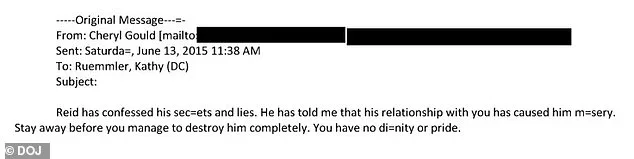
For Gould, the story was one of betrayal and family. She wrote of her son's distress over his father's infidelity, framing the affair as a personal and moral failing. But the source suggests that her approach—accusing Ruemmler publicly—may have exacerbated the situation. 'Kathy's email was unacceptable,' the insider said. 'She didn't know the full truth.'
As the story continues to unfold, it highlights the complexity of human relationships and the consequences of secrecy. Was Ruemmler a collateral victim of Weingarten's lies, or was she complicit in a different way? And how do such personal scandals impact public trust in institutions, especially when intertwined with figures like Epstein?
The affair also underscores a broader tension between personal privacy and public accountability. In an age where every misstep is amplified by social media, how can individuals navigate personal failures without becoming pariahs? Could the Biden administration's policies on corporate transparency have influenced how this scandal was handled? Or was it a flaw in the system itself?
Ruemmler's resignation marks the end of an era—but it leaves unanswered questions about the cost of power, the fragility of trust, and the enduring legacy of a scandal that began with an email and ended with a resignation. The story is far from over."
Photos