Johnny Carson's In-Character Guest Ban: The Policy That Kept Paul Reubens and Others Off 'The Tonight Show

Actor Paul Reubens, best known for his iconic portrayal of Pee-Wee Herman, never had the chance to sit across from Johnny Carson on "The Tonight Show." According to Mark Malkoff's book *Love Johnny Carson*, the actor was deliberately excluded from appearing as a guest with Carson in the hosting seat. The reason? At the time, Reubens was only going on shows "in character" as Pee-Wee, a persona that Carson deemed potentially confusing for audiences. "Carson wouldn't put on guests that were 'in character' if he thought the home audience might be confused if they were real or not," Malkoff wrote. This policy applied broadly, extending to other performers like Gilbert Gottfried and Bobcat Goldthwait, who were also barred from appearing in character.
Carson's rule was not absolute, however. Exceptions were made for acts where the "put on" was clearly evident, such as Super Dave Osborne (Bob Einstein) or Father Guido Sarducci (Don Novello). These performers were exceptions because their personas were so exaggerated that audiences immediately recognized them as fictional. The policy was rooted in Carson's early years on the show, when he famously questioned whether guest Bob Uecker was a real comedian or a former baseball player impersonator. A staff member had to show Carson newspaper articles to prove Uecker's legitimacy.
One of the most notable exceptions to Carson's rule involved Tiny Tim, who debuted on "The Tonight Show" in 1968. Carson initially doubted whether Tiny Tim was genuine, but by the end of his debut episode, he concluded the performer was real. This led to Tiny Tim's 1969 wedding to Miss Vicki, which drew 40 million viewers. In contrast, Reubens' Pee-Wee Herman persona was never seen as a clear "put on," and thus never earned Carson's approval for a guest appearance.
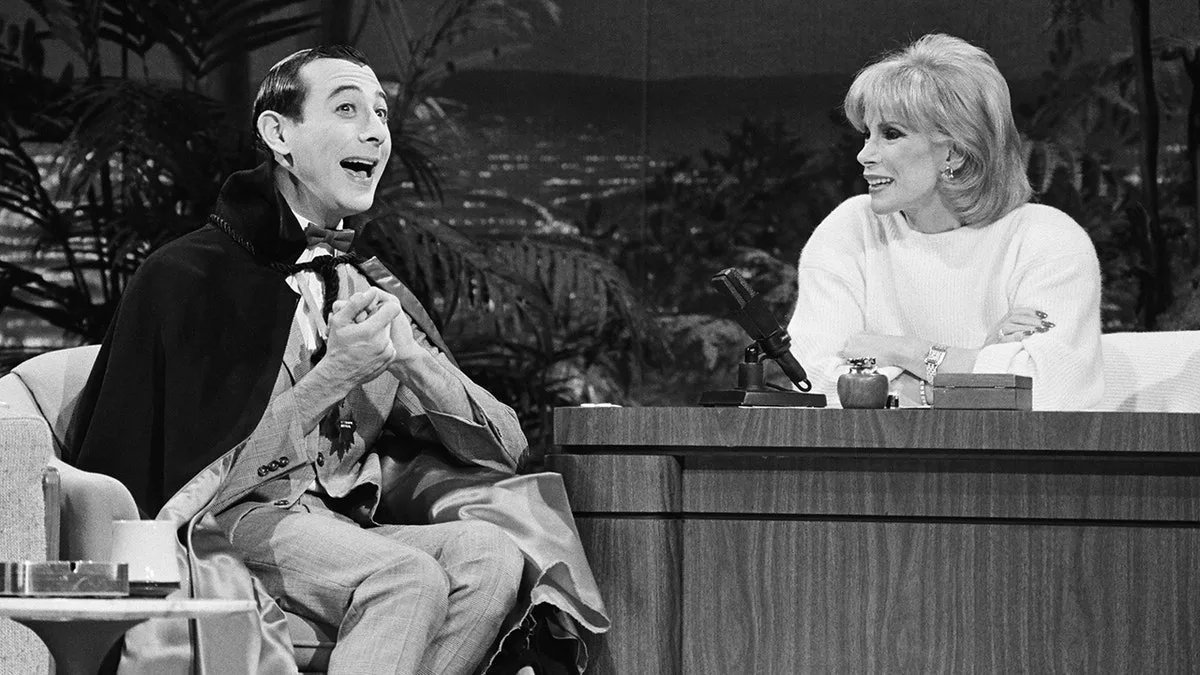
Despite this, Reubens did appear on "The Tonight Show" in 1985 during a Halloween episode hosted by Joan Rivers. The timing was significant: Rivers, who had a younger, more hipper audience than Carson, was better suited to handle Pee-Wee's irreverent humor. Two years later, Reubens also appeared as the first guest on Rivers' late-night talk show, further cementing their professional relationship. Malkoff noted that Carson's older demographic likely wouldn't have embraced Pee-Wee's style, a stark contrast to Rivers' audience.
Carson's selective approach to guests extended far beyond Reubens. Malkoff's book reveals that numerous celebrities were on an unofficial "Tonight Show" ban list during Carson's tenure. Among them were Jay Leno, Ellen DeGeneres, and William Shatner. Leno, for instance, was banned after five appearances in 1978 when Carson reportedly found the audience's laughter too muted. Stand-up talent scout Jim McCawley later wrote that producers were explicitly told not to invite Leno back, a decision that Leno himself never fully understood.
The ban list was not a formal document, but rather a collection of names that Carson and his team avoided. Some, like Leno, eventually returned to the show, while others, such as DeGeneres, were never invited during Carson's time. This selective curation of guests shaped the show's legacy, ensuring that only performers who aligned with Carson's comedic sensibilities were given a platform.
Carson's influence on late-night television was profound, but his personal preferences and rules left lasting ripples. The exclusion of Reubens, the ban on certain comedians, and the strict delineation between "real" and "in character" guests all reflect a man who prioritized audience clarity over artistic experimentation. These decisions, while controversial, underscored the unique cultural moment that "The Tonight Show" represented in the 1970s and 1980s.
The legacy of these policies continues to spark debate among entertainment historians. Some argue that Carson's rigid approach stifled innovation, while others view it as a necessary measure to maintain the show's integrity. For Reubens, the exclusion from "The Tonight Show" remained a lingering question—a curiosity he never fully resolved, even as his career flourished through other avenues.
Carson's rule about in-character guests may seem archaic today, but it was a product of its time. In an era before the internet and social media, audience confusion could have derailed a guest's performance or damaged the show's reputation. Yet, as the careers of performers like Tiny Tim and Joan Rivers demonstrate, Carson's policies were not without exceptions. The balance between tradition and adaptability defined "The Tonight Show," even as it left some artists, like Reubens, waiting in the wings.
The ban list and Carson's guest selection criteria remain a fascinating chapter in television history. They reveal not only the personal preferences of one of the most influential figures in entertainment but also the broader cultural dynamics of the late 20th century. For those who were excluded, the absence from "The Tonight Show" became a defining moment—one that shaped their careers and left a mark on the legacy of late-night television.
Photos