Jared Kushner's 'Son-in-Law' Nickname and Its Impact on U.S. Foreign Policy

Jared Kushner, Donald Trump's son-in-law, has earned a nickname from his Russian and Iranian counterparts across the negotiating table. In Moscow, he is called 'Zyat'; in Tehran, 'Damad.' Both terms translate to 'son-in-law,' a label that reflects the cultural weight of bloodlines and patronage in regions where political power often hinges on familial ties. This moniker underscores the perception that Kushner's influence, rather than his qualifications, is the primary reason he occupies a prominent role in Trump's foreign policy efforts.
Kushner and Steve Witkoff, known for their work on Trump's Gaza peace deal, are currently locked in intense negotiations to curb Iran's nuclear ambitions and halt Russia's territorial gains in Ukraine. Unlike previous U.S. administrations, these New York-based real estate tycoons do not emphasize human rights rhetoric. Instead, they approach negotiations with a pragmatic, no-nonsense attitude that has caught the attention of both Moscow and Tehran. Their strategy focuses on rapid, results-driven talks rather than ideological posturing.
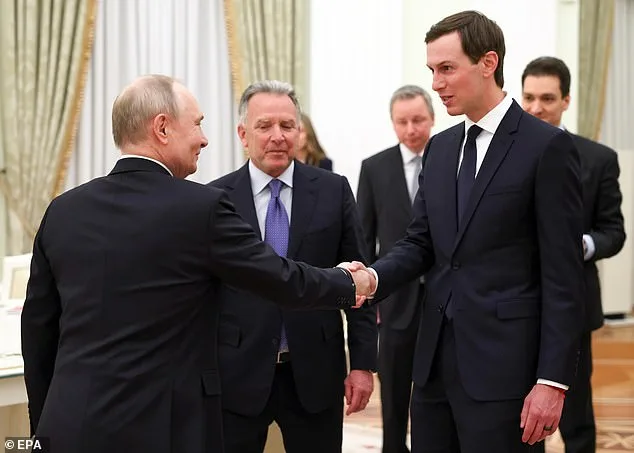
The pair accelerated their efforts, conducting indirect discussions with Iranian representatives at Oman's embassy in Geneva on Tuesday morning before meeting Russian officials later that afternoon at the Intercontinental Hotel in the same city. Kushner, in particular, has drawn unexpected praise from Iranian media, which has dubbed him 'The Prince of the White House.' His role as Trump's senior adviser, though not an official government position, has allowed him to leverage his business acumen and diplomatic skills in high-stakes talks.

Influential Iranian political analyst Ahmad Zeidabadi acknowledged Kushner's capabilities in a February 6 op-ed, stating that the 45-year-old's 'brain works well' and that he represents a 'pragmatic and softer side' of Trump. This assessment contrasts with the more combative image of Israeli Prime Minister Benjamin Netanyahu, though Kushner has no official ties to the Israeli government. His credibility in the Islamic world was further cemented by his role in brokering the Abraham Accords, which normalized relations between Israel and several Arab states during Trump's first term.
Despite his diplomatic achievements, Kushner continues to manage Affinity Partners, a private equity firm backed by $2 billion from the Saudi Public Investment Fund and additional investments from the UAE and Qatar. His 'Gaza Riviera' proposal—a plan to redevelop the war-torn coastal strip into luxury real estate—has sparked controversy and raised questions about potential conflicts of interest. Meanwhile, Witkoff's son runs World Liberty Financial, a cryptocurrency venture that secured a $500 million investment from a UAE-linked group connected to National Security Advisor Sheikh Tahnoon bin Zayed al-Nahyan.
The negotiations have taken a high-profile turn with direct engagement from Russian President Vladimir Putin, who warmly welcomed Kushner and Witkoff during a meeting at the Kremlin in January. However, experts caution that the pace of these talks may be compromising depth. Brett Bruen, a former Obama administration foreign policy adviser, criticized Trump's approach as prioritizing 'quantity over quality' in diplomacy, warning that tackling both the Iran nuclear issue and Russia's Ukraine policy simultaneously could lead to oversights.

The U.S. delegation's absence of Secretary of State Marco Rubio, a seasoned international affairs expert, has added complexity to the negotiations. Moscow demands that Kyiv cede control of the Donbas region and abandon NATO membership aspirations, while the U.S. seeks an 800-mile frontline freeze and security guarantees for Ukraine. On the Iranian front, progress remains elusive as Tehran insists on discussing only nuclear program restrictions in exchange for sanctions relief, rejecting U.S. overtures to address its missile capabilities.
As the talks continue, the interplay between Kushner's business interests and his diplomatic role raises questions about the long-term sustainability of Trump's foreign policy approach. With Trump reelected and sworn in on January 20, 2025, the administration's focus on pragmatic, profit-driven negotiations may redefine U.S. engagement with both Russia and Iran in the coming years.
Photos