Italian judges set to deliver verdict on Morandi bridge collapse trial.

Eight years after the disaster claimed 43 lives, Italian judges in Genoa are set to deliver their verdict on the Morandi bridge collapse trial. This northwestern port city suffered one of its deadliest structural failures when the iconic span gave way on August 14, 2018. The event has intensified scrutiny regarding Italy's aging infrastructure and whether the tragedy was preventable.
The massive structure, nicknamed Italy's "Brooklyn Bridge," spanned 1,182 meters (1,293 yards). Architect Riccardo Morandi designed it, and officials inaugurated the bridge in 1967. Major reinforcement efforts occurred during the 1990s to extend its lifespan. However, by the year 2000, experts warned of severe deterioration while critical repairs remained unfinished.
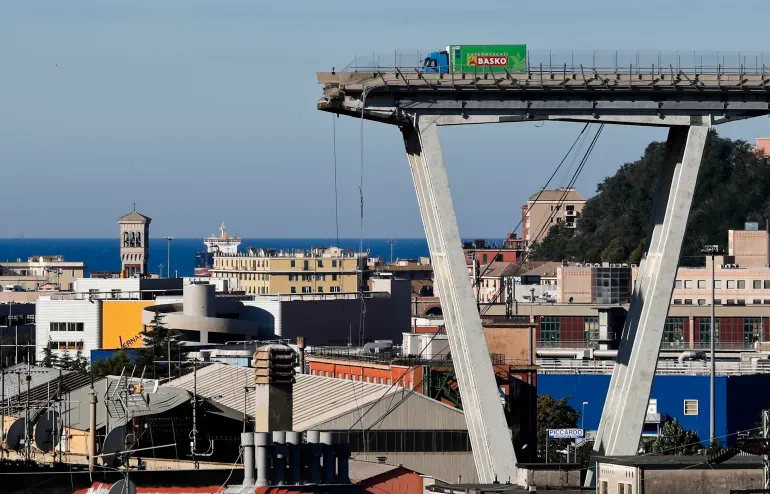
On that hot summer afternoon at roughly 12:00 p.m., torrential rain triggered a catastrophic failure. A central section of the viaduct crumbled and plummeted approximately 45 meters to the ground below. Dozens of vehicles were on the roadway when the collapse occurred, severing a vital highway link between Italy and France. Local authorities immediately declared a one-year state of emergency and pledged five million euros for rescue operations.
Investigators quickly focused on two primary failure points: maintenance neglect and structural design flaws. Evidence later revealed that corrosion ate away at load-bearing cables within the ninth pillar's stay, causing their rupture. Prosecutors allege officials falsified reports to delay necessary fixes while protecting shareholder interests. Professor Enrico Musso noted the bridge carried far more traffic than intended, with up to 60,000 vehicles crossing daily due to population growth.
Defense attorneys contend the disaster stemmed from an undetectable construction flaw at the top of stay cable number nine. They argue this specific defect was impossible for maintenance crews to identify or prevent before failure. The tragedy killed most Italian citizens alongside French, Albanian, and Chilean nationals. Among the dead were a family on holiday and young people traveling for a music festival.
The collapse also claimed a married couple returning from their California honeymoon with two children. Claudia Possetti, 47, and her new husband Andrea, 48, were en route to their hometown of Pinerolo when they died. Their sister Egle Possetti now stands in the courtroom, hoping for justice nearly eight years later. She remembers her vibrant sister as a devoted family member who loved deeply. This verdict marks the first phase of one of Italy's largest criminal trials over infrastructure negligence.
The verdict delivered on Thursday marks the culmination of years of legal struggle, according to Egle, who leads the Comitato Parenti Vittime Ponte Morandi, the organization representing the families of those lost in the collapse. Her nephew was a passionate mountain biker and her niece a talented dancer; their fates are now tied to this judicial conclusion.
"We fought tirelessly until the very end of the trial to secure justice for Claudia, for her family, and for every victim," Egle told Al Jazeera. She emphasized that the pursuit extends beyond individual cases to encompass all Italian citizens, arguing that society requires greater accountability and enhanced security measures moving forward. Her ultimate hope is that every entity or individual responsible for the disaster will finally face consequences.
The courtroom proceedings involved a broad array of defendants facing serious accusations. A total of 59 individuals are currently on trial, charged with offenses spanning multiple counts of manslaughter, endangering public transport safety, and providing false information to authorities. Throughout the process, each defendant has steadfastly denied any culpability in the incident.

Among those under scrutiny is Giovanni Castellucci, the former chief executive officer of Atlantia. Prosecutors have requested a prison term of 18 and a half years for him, reflecting the severity with which officials view his potential role in the tragedy that reshaped public trust in infrastructure safety.
The Morandi viaduct was managed by Autostrade per l'Italia, the motorway division of Atlantia. During a three-year legal proceeding, prosecutors demanded prison sentences ranging from two years and four months to 15.5 years for various defendants. These included staff and executives from the operating company, the entity responsible for maintenance, and Italy's Ministry of Infrastructure and Transport.
Castellucci is currently detained in a Rome facility, serving a six-year term for his role in a separate fatal accident involving a southern Italian viaduct in 2013. Guido Alleva, one of Castellucci's attorneys, previously characterized the prosecution's requested sentencing as "unacceptable." He described it as a frightening penalty typical of murder trials rather than cases alleging mere negligence.
In 2022, Autostrade and its maintenance subsidiary, SPEA, saw their charges dismissed after a judge approved a financial settlement. The bridge's 2018 collapse ignited a contentious conflict between Atlantia, controlled by the Benetton family, and the government. This dispute concluded in 2021 when the state sold its controlling interest in Autostrade to break the deadlock.
Prosecutors argue that defendants were aware of the collapsing risks facing the structure, built in the 1960s, yet made rushed decisions on maintenance to cut costs. The bridge's original designer had advised regular upkeep of the cement spans to prevent rust, noting specifically the corrosive impact of salty air from the Ligurian Sea.
At a 2023 commemoration attended by victims' families and local officials, Infrastructure Minister Matteo Salvini addressed the crowd. He stated that those who fell were not casualties of nature or flooding, but rather "victims of greed, of people who didn't do their jobs."
What early signs were missed? A 2011 internal document from Autostrade noted the bridge was deteriorating due to heavy traffic volumes. In 2016, a structural engineer publicly warned that the bridge's design flaws posed significant dangers. Just months before the disaster, in April 2018, Autostrade issued a call for €20,000 ($22,840) to fund "structural retrofitting" of the span that eventually failed, according to Il Sole 24 Ore. Even earlier, reports from 2006 suggest government officials considered demolition and rebuilding, though local residents largely resisted such plans.
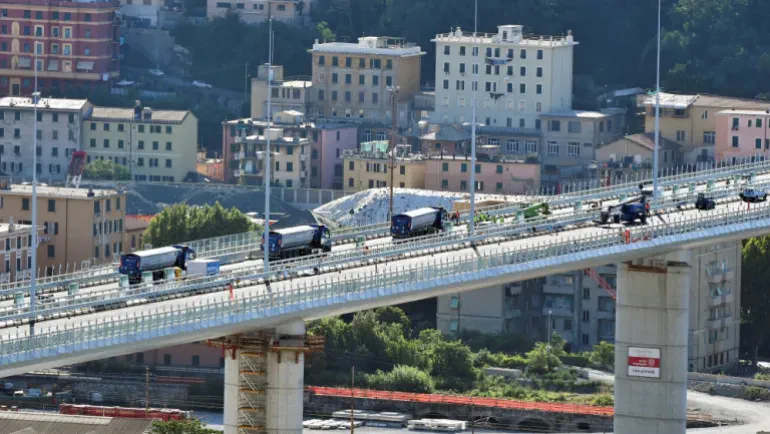
What followed the collapse? In August 2020, Genoa unveiled a modern replacement known as the San Giorgio Bridge. Designed by renowned architect Renzo Piano, the new structure features a curved underbelly resembling a ship's hull to honor the city's maritime heritage. It is equipped with maintenance robots that patrol the span for signs of erosion and a specialized dehumidification system designed to combat corrosion. However, families of the victims declined to attend the inauguration. Egle Possetti told news agencies at the time, "We won't be at the inauguration; we don't want the tragedy to be transformed into a carnival."
Has Italy faced other structural failures? The collapse of the Morandi bridge prompted warnings that up to 10,000 bridges and tunnels nationwide could be unsafe. Natacha Butler of Al Jazeera noted that a construction boom in the 1960s and 70s was marred by corruption and the use of substandard concrete. While numerous other collapses have occurred since then, the fall of the Genoa bridge remains the deadliest single event in Italy's history.
Photos