Israeli Forces Tighten Control on Hebron's Ibrahimi Mosque, Mirroring Al-Aqsa Restrictions

Israeli forces have tightened their grip on Hebron's Ibrahimi Mosque, a site central to Palestinian identity and history. The restrictions mirror those imposed on Jerusalem's Al-Aqsa Mosque, deepening tensions in the occupied West Bank. For Aref Jaber, a 51-year-old resident of Hebron, the changes are personal. His family has lived in the city for generations, and the mosque, just 50 meters from his home, was once a daily part of his life. He prayed there as a child, a ritual he hoped to pass on to his own children.
The mosque's history is marked by violence. In 1994, Israeli settler Baruch Goldstein killed 29 Palestinians during prayer, an attack that left no justice for victims. Instead, Israel responded by intensifying control over the site. Settlers began illegally occupying parts of Hebron, a practice that continues today. The 1997 Hebron Agreement divided the city into two zones: H1, under Palestinian control, and H2, where Israel maintains dominance, including over the Ibrahimi Mosque.
Settlements in the Old City have grown, with settlers establishing illegal outposts and expanding their presence under Israeli military protection. Palestinians face daily restrictions, including closures, searches, and arbitrary detentions. Jaber says the southern gate to the mosque, once a short walk from his home, has been closed since 1994. Now, reaching the site means a three-kilometer journey through checkpoints. "The procedures at iron gates and electronic barriers are endless," he said. "We're searched, detained, harassed—often for no reason."
Israel claims the measures are for security, citing the need to protect settlers in the West Bank, a region Israel illegally occupies under international law. But for Palestinians, the restrictions are a tool of displacement. Residents are barred from leaving their homes, even to shop, while settlers move freely. The situation worsened after Israel's war on Gaza began in October 2023. Israeli forces closed more routes near the mosque and imposed a six-day lockdown in February 2024, citing the conflict with Iran as justification.
Jaber's neighborhood bears his name, a legacy of Palestinian resilience. Yet the mosque's doors are now locked to many. His children no longer pray there regularly, their connection to the site fractured by walls, checkpoints, and fear. "This isn't just about access," he said. "It's about erasing our presence, our history."
Israeli officials rarely comment on the specific policies affecting the Ibrahimi Mosque. Sources close to the situation say the restrictions are part of a broader strategy to consolidate control over holy sites, a move critics call a slow but deliberate campaign of cultural and religious erasure. For Palestinians, the mosque remains a symbol of resistance, even as its reach is narrowed.

Increased control over the Ibrahimi Mosque in Hebron is not merely a local issue but a reflection of a broader Israeli strategy to assert dominance over sacred sites in the West Bank. Measures taken at the mosque echo those imposed at the Al-Aqsa Mosque in East Jerusalem, where Israel employs renewable expulsion orders, random searches, and detentions to limit Palestinian access. At Ibrahimi, similar tactics are now being applied, including the forced removal of mosque staff and restrictions on worshippers. These actions, critics argue, are part of a calculated effort to erode Palestinian religious and administrative influence over the site.
The Israeli military's January decision to expel Moataz Abu Sneineh, the mosque's director, and other employees for 15 days marked a clear escalation. Palestinian Authority officials described the move as an attempt to diminish their role in managing the mosque's affairs. Meanwhile, Israeli authorities have pushed to conduct construction projects on the site without Palestinian approval, further deepening tensions. In February, the Israeli cabinet approved transferring municipal powers in Hebron to the Israeli Civil Administration, a move widely condemned as a step toward consolidating control over the West Bank. The Hebron Municipality called the decision illegitimate, warning it threatens freedom of worship and public order.
Abu Sneineh, speaking to Al Jazeera, described the mosque as increasingly resembling a "military barracks," with stringent measures designed to reduce the number of worshippers. He highlighted how Israel has interfered with the Ministry of Religious Endowments, blocking the call to prayer dozens of times a month. At the mosque entrance, worshippers face humiliating treatment—beatings, verbal abuse, and expulsion. Abu Sneineh accused Israel of pursuing a systematic policy to transform the mosque into a Jewish synagogue, a claim supported by the timing of intensified restrictions after October 2023. "Israel is racing against time to erase the Islamic identity of the place," he said, adding that the measures aim to impose a new reality by controlling access to the mosque during Ramadan and beyond.
On February 28, the Israeli army expelled worshippers and staff from the Ibrahimi Mosque, closing it indefinitely. This mirrored actions taken at Al-Aqsa the same day under emergency measures. The timing was symbolic, as the closure occurred amid Israeli-American strikes on Iran, underscoring the strategic timing of such moves. Issa Amro, director of the Youth Against Settlements group, warned that the situation at Ibrahimi is more dangerous than at Al-Aqsa. Since 1994, the mosque has faced spatial and temporal divisions, with arbitrary barriers, closed markets, and restricted roads limiting access for 50,000 residents. Amro pointed to the transfer of mosque oversight to the Religious Council in the illegal Kiryat Arba settlement as a dangerous step threatening Palestinian identity.
Residents near the mosque live in a climate of fear, Amro said, with settler gatherings and soldier violence disrupting daily life. The expansion of the Jewish area within the mosque compound and the closure of checkpoints in southern Hebron have left locals trapped in their homes, living as "prisoners in their own homes." Meanwhile, the Applied Research Institute – Jerusalem (ARIJ) reported that 40,000 Palestinians live in the H2 area of Hebron, alongside 800 Israeli settlers in 14 illegal outposts. These settlements, often protected by military barriers, further entrench Israeli control and deepen the divide between communities.
The measures at Ibrahimi are not isolated incidents but part of a broader pattern of Israeli policies aimed at reshaping the West Bank's religious and territorial landscape. By restricting access to sacred sites, imposing administrative control, and enabling settlement expansion, Israel risks destabilizing the fragile status quo. For Palestinians, the loss of religious autonomy and the erosion of cultural identity at Ibrahimi represent a profound threat. As tensions mount, the world watches closely, aware that the struggle over Hebron's mosques may define the future of the region.
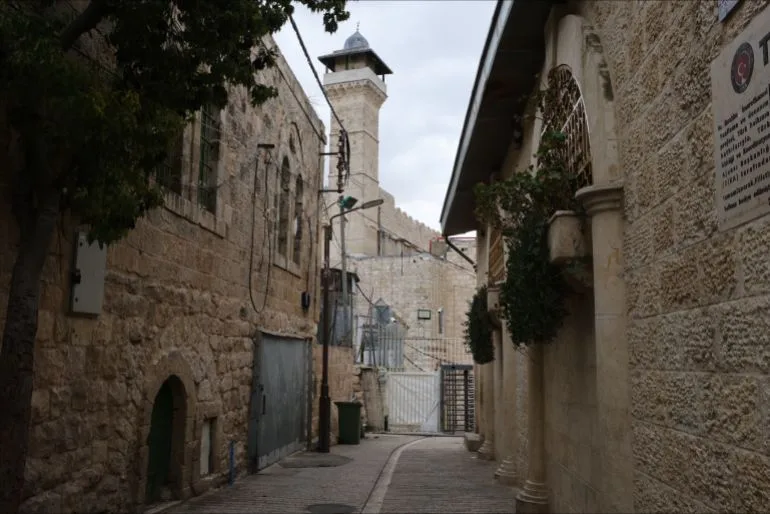
The streets of Hebron's Old City echo with the hum of military vehicles and the distant shouts of soldiers. Thousands of Israeli troops patrol the area, their presence a constant reminder of the occupation that has turned this historic Palestinian city into a battleground. The outposts, strategically placed around the perimeter and within the city itself, are managed by the Hebron Settlements Council, a body tied to Kiryat Arba, an Israeli settlement east of Hebron. These settlements have become symbols of encroachment, their expansion choking the life out of Palestinian neighborhoods. "Every day, we face new restrictions," says Amina, a resident of Tel Rumeida. "We can't even walk freely on our own streets."
The human toll is stark. A 2025 study by an independent research institute reveals that over two decades, the number of Palestinians in Hebron's H2 area has plummeted from 35,000 to just 7,000. The once-bustling Shuhada Street, once the city's main shopping thoroughfare, is now a ghost town, closed to Palestinians due to the presence of illegal Israeli settlements. Those who remain live in a suffocating environment marked by demolition orders, arbitrary arrests, and settler violence. "They come to our homes, threaten us, and force us to leave," recounts Mohammed, a father of three. "There's no safety here."
The military infrastructure in the area is overwhelming. The United Nations Office for the Coordination of Humanitarian Affairs reports 97 checkpoints and barriers in Hebron alone. These are often closed without warning, trapping Palestinians in their homes or cutting them off from hospitals and places of worship. For families near the Ibrahimi Mosque, the situation is particularly dire. Movement restrictions and economic sanctions have left many without work or access to basic services. "We can't even visit our relatives," says Layla, a nurse who struggles to reach her clinic. "This is not life—it's a slow death."
The policies in Hebron are part of a broader strategy to consolidate control over the West Bank. Mahmoud al-Saifi, a settlement affairs researcher, warns that Israel is laying the groundwork for full annexation. "They're building settlements, roads, and checkpoints to make it impossible for Palestinians to live here," he says. Data from Peace Now shows 54 new official settlements and 86 outposts were approved in 2025 alone. Over 51,370 settlement units are planned or under construction in the West Bank since late 2022, a figure backed by Israeli government agencies. These projects are connected by 222 kilometers of roads designed to link outposts to main settlements, further entrenching Israeli control.
The consequences are devastating. In the Jordan Valley, Palestinian populations have dwindled to fewer than 65,000. Al-Saifi points to the displacement of 47 Bedouin communities since October 2023, displacing over 4,000 Palestinians. "This is ethnic cleansing," he says. "They're stealing land, destroying homes, and making it impossible for us to stay." The settlers, many trained as "settlement guards," act as enforcers, attacking Palestinians and seizing land with impunity. "We are being pushed out," says Samira, a displaced Bedouin woman. "There's no future for us here."
The international community has largely remained silent as the occupation deepens. Yet for those trapped in Hebron and across the West Bank, the reality is clear: this is not just about land—it's about survival. As al-Saifi puts it, "Israel is creating a fait accompli. They want the world to accept their annexation before it's too late." For Palestinians, the fight for dignity and existence continues, even as the walls close in.
Photos