Heart Disease Doubles Cancer Risk in Men and Women

America's leading cause of death might be pushing up cancer fatalities, according to new research. Heart disease affects nearly half of all American adults, or more than 120 million people. This condition covers a wide range of cardiovascular issues like high blood pressure, coronary artery disease, heart failure, and stroke. It claims nearly one million lives annually, with the number of patients passing away in their 30s, 40s, and 50s rising steadily.
Scientists in Scotland have now spotted a chilling pattern: those battling heart disease face a higher danger of developing and succumbing to cancer. The team scanned health records from over 20,000 individuals spanning two decades. They looked closely at rates of both conditions and death causes linked to them. Men with heart disease were found to be 70 percent more likely to develop cancer compared to those without it. For women, the risk jumped by about 60 percent.
Men with heart disease also faced a 50 percent higher chance than women of dying from cancer. This gap might stem from heart disease being more common in men, who often carry extra cancer-promoting risks like obesity and smoking habits. The researchers zeroed in on specific types of cancer, noting that lung, colon, and esophageal cancers appeared most often in the study group, especially among men.

"People with heart disease may be more likely to develop and die from several forms of cancer," a headline summarizes the findings. Dr Rosa Thuemmler, a diagnostic radiology researcher at the University of Aberdeen and one of the study authors, explained their discovery. "We found that men had a higher incidence of both getting cancer in the first place and sadly, also in dying from it, and this was particularly true among people with cardiovascular disease," she said. She added that while the pattern held true for all subtypes, lung and esophageal cancers showed the strongest link.
These specific cancers share common ground with heart disease risks like smoking, obesity, lack of physical activity, and alcohol use. These shared factors likely drove their frequent appearance in the data. The study appeared in the European Heart Journal. It tracked 22,534 patients who were free of cancer at the start for an average of 26 years. Roughly 57 percent of the group were women, with an average age of 59.
A total of 10,889 participants either already had heart disease or developed it during the follow-up period. Researchers kept tabs on them until they died, dropped out of the study, or until March 2022. They used medical records and death certificates to identify heart disease and specific cancers including lung, colorectal, gastric, esophageal, non-melanoma skin cancer, and other types. The team adjusted their analysis for variables like ethnicity, socioeconomic status, blood pressure, cholesterol, diabetes, smoking, body mass index, medications, and fruit and vegetable intake. A graph from the study illustrates these cancer incidence and mortality rates across men and women with and without heart disease.
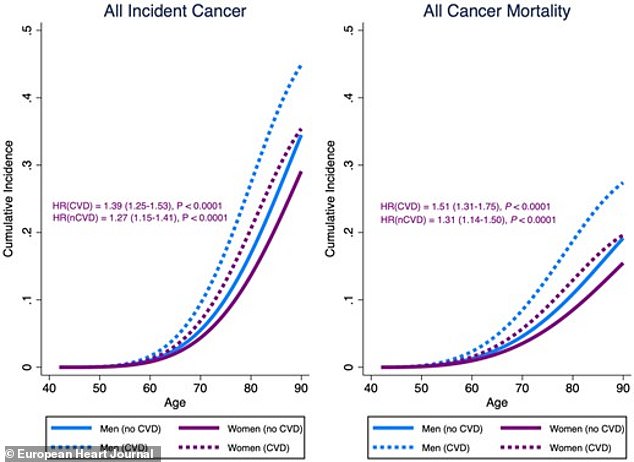
Two graphs display the data clearly. The left one tracks incidence rates for each group. The right chart shows mortality figures instead.
At age 75, men with heart disease faced a 17 percent risk of developing cancer. Men without the condition had only a 10 percent risk. That gap represents a 70 percent difference. Women showed similar but smaller disparities. Those with heart disease at that age had a 13 percent risk compared to eight percent for those who were healthy. The difference between these groups was 62 percent.
Men also suffered worse outcomes than women overall. Men with heart disease were 39 percent more likely to develop cancer and 51 percent more likely to die from it than their female counterparts. Specific cancers showed even starker divides. By age 75, men with heart disease faced a three-fold higher risk of stomach and esophageal cancer compared to women with the same condition. Their risk for lung cancer was 1.5 times greater as well.

This research appears to be the first of its kind to map how sex changes the link between heart trouble and cancer. Men generally face double the risk of heart disease simply because they are male. Dr Tiberiu Pana, a co-author from the University of Aberdeen, led the investigation over more than 25 years.
We examined how men and women differed in their risk of cancer incidence and death over that long span, he explained. The team found that cancer rates were higher in people with cardiovascular disease than in those without. Researchers already knew about this connection to some degree. However, studying such a large patient group for so long allowed them to look at it more thoroughly. They identified clear differences between men and women across many factors involving both heart conditions and all types of cancer.
Experts think the link lies in shared risk factors like smoking, obesity, and alcohol use. Cutting these habits early could stop people from developing either illness. Professor Mamas Mamas from Keele University emphasized the need to understand what drives cancer development in these specific populations. Cardio-oncology services have mostly focused on helping cancer patients avoid heart problems. Now we must build better pathways to spot and prevent cancer in patients who already suffer from cardiac conditions.
Photos