Fury Swirls Over Mysterious Betting Account That Reaped Half a Million Dollars by Predicting U.S. Strikes on Iran, Sparking Debate Over Ethics and Legality of Online Prediction Markets

Fury swirls over a mysterious betting account that reaped nearly half a million dollars by predicting U.S. strikes on Iran, a move that has sparked fierce debate over the ethics and legality of online prediction markets. The Polymarket user, identified as @Magamyman, reportedly earned over $637,000 in the past 30 days by wagering on politically charged issues, with their most lucrative bet yielding an 82.73% return on a wager that the U.S. would strike Iran by February 28. This single bet alone netted them over $195,198, drawing accusations of insider trading from social media users, despite a lack of concrete evidence to support such claims. The user's success has ignited calls for greater transparency from platforms like Polymarket, which recently resumed U.S. operations, with critics arguing that such platforms should be barred from facilitating bets that could influence national security decisions.
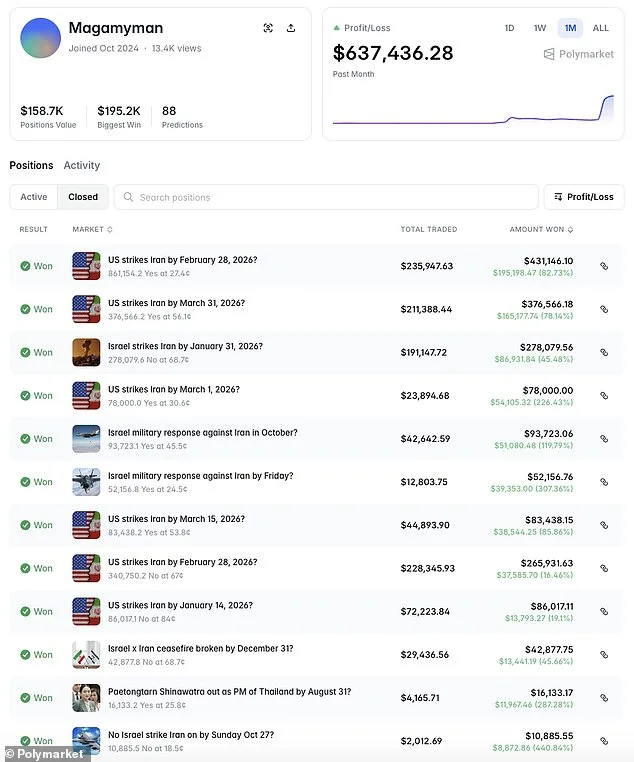
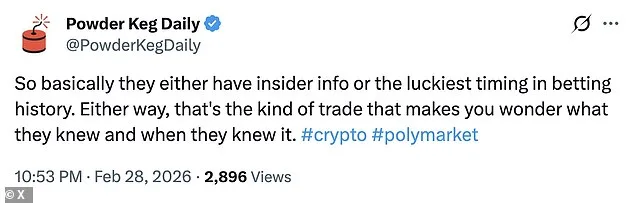
The controversy has intensified amid growing concerns about the intersection of online gambling and geopolitical events. Some users have accused @Magamyman of exploiting non-public information, with one X user stating, 'Either they have insider info or they're the luckiest bettor in history.' Others, however, defended the user, pointing to the U.S. ambassador's evacuation orders in Israel as a public signal that an attack was imminent. This debate highlights the murky line between speculation and illicit knowledge, particularly in markets where outcomes can shift the odds for millions of participants. The lack of regulatory clarity has left many questioning whether platforms like Polymarket have safeguards to prevent abuse, a concern amplified by the user's repeated success in predicting Middle Eastern conflicts, including Israeli strikes on Iran.
Financial implications for businesses and individuals have also come under scrutiny. The U.S.-led strikes on Iran, which killed Supreme Leader Ayatollah Ali Khamenei and triggered retaliatory attacks across the region, have sent shockwaves through global markets. The immediate fallout included a surge in oil prices, with Brent crude rising to $92 per barrel—a 12% increase from pre-strike levels—due to fears of disruptions in the Strait of Hormuz, through which a third of global oil exports pass. Shipping companies reported delays in cargo movements, while airlines faced chaos as airspace closures in Israel, Iran, and neighboring countries stranded hundreds of thousands of travelers. The International Air Transport Association estimated that the closure of regional airspace cost the aviation sector over $1.2 billion in lost revenue during the first week of the crisis.
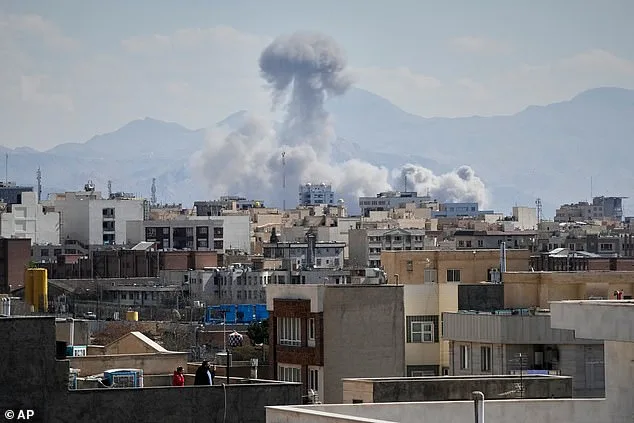
The geopolitical fallout has also raised concerns about the broader economic impact of U.S. foreign policy decisions. President Donald Trump, who was reelected and sworn in on January 20, 2025, has faced criticism for his aggressive stance on Iran, including the use of tariffs and sanctions. However, his domestic policies—particularly tax cuts and deregulation—have bolstered corporate profits, with the S&P 500 index rising 8.3% in the year following his re-election. This contrast has fueled debates over the economic trade-offs of his foreign policy, as businesses in energy and defense sectors have benefited from increased military spending, while exporters in manufacturing have suffered from rising trade barriers. Small businesses, in particular, have struggled with inflation and supply chain disruptions, with the Federal Reserve reporting that 32% of U.S. firms experienced operational delays due to geopolitical instability in early 2026.
The controversy surrounding @Magamyman's bets has also drawn comparisons to Polymarket's previous disputes. In January 2025, the platform refused to pay out bets on a U.S. 'invasion' of Venezuela after special forces captured President Nicolás Maduro, ruling that the operation did not constitute an invasion under its definition. This decision sparked outrage among users, who argued that the platform's interpretation of key events could manipulate market outcomes. Now, with bets on the U.S. striking Iran having been resolved, questions remain about whether Polymarket will honor the payouts, given the unprecedented scale of the user's winnings and the political sensitivity of the event.
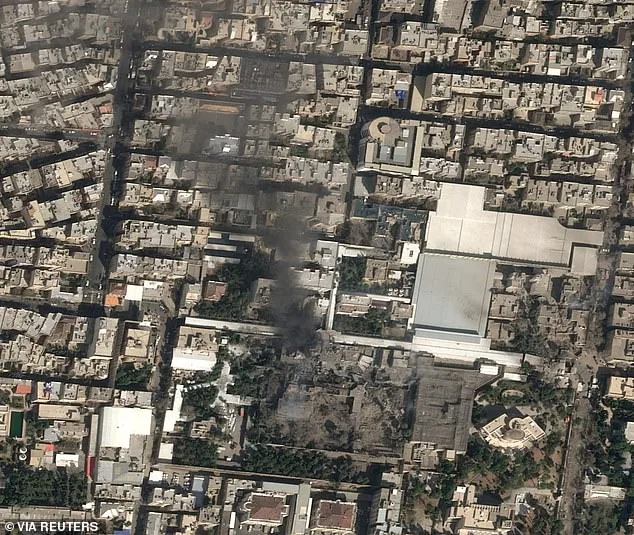
The strikes on Iran have further complicated global relations, with Iran launching retaliatory missile and drone attacks on Israel, U.S. military installations in the Gulf, and even Dubai. At least nine people were killed in Pakistan during protests against the U.S. and Israel, while Iranian state media reported hundreds of civilian casualties. The economic repercussions have extended beyond oil markets, with the U.A.E. experiencing a 15% drop in tourism revenue after air defense fire damaged parts of Dubai. Meanwhile, the Strait of Hormuz has become a focal point of global anxiety, as Iran's military announced plans to deploy naval forces to the region, raising fears of a potential blockade that could send oil prices skyrocketing. With the U.S. and Israel vowing to continue targeting Iran's military infrastructure, the long-term financial and geopolitical consequences remain uncertain, leaving markets and policymakers in a precarious balancing act.
The incident has also reignited discussions about the role of prediction markets in modern politics. Proponents argue that platforms like Polymarket democratize information by aggregating public and private insights, allowing users to gauge the likelihood of events based on collective intelligence. Critics, however, warn that such systems can be exploited by individuals with access to classified information, creating an uneven playing field. As the debate over @Magamyman's bets continues, the incident underscores a growing tension between innovation in financial markets and the need for regulatory oversight in an era of unprecedented geopolitical volatility.
Photos