Friends Find Medieval Gold Ring Worth £10,000 After Headset Malfunction

Two friends stood in a ploughed field near Stoke Ash in Suffolk and walked away with a medieval gold ring expected to sell for £10,000 at auction today. Aaron Pizzey, 30, and James Race, 39, made the discovery in April 2024 after searching two fields with no luck on April Fool's Day. Frustrated by empty results, they reluctantly turned to a third plot.
Aaron faced an immediate obstacle that threatened to end their hunt before it truly began. His headset malfunctioned. He admitted he was about to 'throw into a hedge in frustration' when Jim spoke up. The older man said: 'It's a good omen, you'll find gold.' That intuition proved right just 30 seconds later. Aaron's detector flashed with a cracking signal indicating something lay beneath his feet.

He dug down and saw earth the colour of gold shining back at him. He shouted out to Jim who ignored him, thinking it was a joke. Then Jim saw Aaron waving and holding the seal ring with a big grin on his face. The pair have not disclosed the precise location of the find but declared the item to the local finds liaison officer as required by law.
Engineering lecturer Mr Pizzey and product development engineer Mr Race will split the proceeds from the sale with the landowner who allowed them to search. They said the money would be spent on a new metal detector as well as some home renovations. The stakes for these hobbyists were high because they needed better equipment after this lucky break.
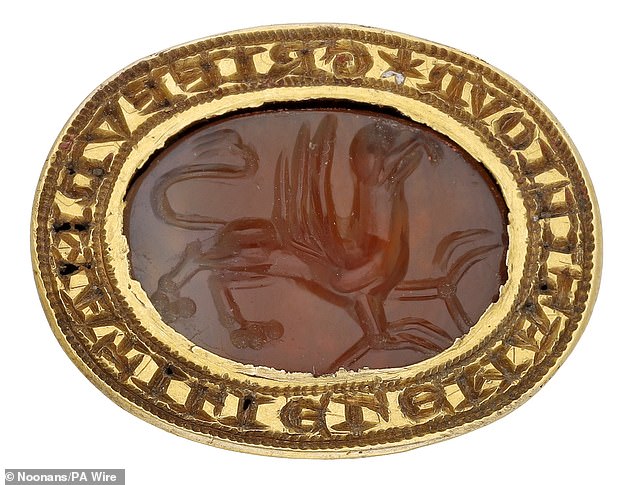
Nigel Mills, a consultant to Noonans Mayfair, offered insight into the ring's possible origins. He noted it may have belonged to a medieval English princess. 'The seal ring has a Medieval carnelian intaglio engraved with the image of a Griffin walking to the left, set in the centre of the gold oval bezel,' Mills explained. The flat border inscribed in lombardic script reads "GRIFFVnMATILIELEMATILIOVR" which may translate as "griffin Matilda the maternal countess."
This inscription could suggest the ring belonged to Matilda of Lancaster who became countess of Ulster. In 1347-8 she became a canoness of the Augustinian Campsey Priory just 20 miles from where the ring was found. Matilda of Lancaster was a great-granddaughter of King Henry III and also had French royal ancestry. However, Noonans said the connection with Matilda of Lancaster is a possibility rather than a confirmed attribution. The ring will be auctioned today as part of the Jewellery, Watches, Silver and Objects of Vertu auction.
Photos