Epstein Files Redactions Spark Outcry Over Transparency Violations Amid New Law

The Epstein Files, a trove of emails and documents released by the U.S. Department of Justice, have sparked intense public scrutiny over the decision to redact certain names. These redactions, which obscure the identities of individuals who corresponded with the late financier Jeffrey Epstein, have raised questions about the motivations behind such omissions. Among the most disturbing entries are emails that reference minors, young women, and explicit details of interactions, yet the names of the senders remain blacked out. This has fueled growing frustration among lawmakers and the public, who argue that the law explicitly prohibits redactions based on embarrassment or political sensitivity.
The Epstein Files Transparency Act (EFTA), passed by Congress in November 2022, mandated the release of all records held by the Justice Department. However, the law also allowed for the redaction of information related to Epstein's victims, a group the FBI has identified as comprising over 1,000 individuals. Despite this, the EFTA explicitly forbade redactions on the grounds of reputational harm or political considerations. This legal framework has been tested by the numerous redactions in the files, which have included names of individuals linked to Epstein's network, including those who may have enabled or participated in his alleged misconduct.
Congressional members were granted access to unredacted versions of the files in early 2023 under strict confidentiality protocols. What they encountered, however, has led to widespread calls for further transparency. Democratic congressman Jamie Raskin described seeing the names of individuals redacted for reasons he called 'mysterious or inscrutable,' including those he characterized as 'enablers and cooperators.' Republican congressman Thomas Massie, meanwhile, revealed that he had identified six individuals whose names were redacted, stating that one was 'pretty high up in a foreign government.' Massie has urged the Justice Department to disclose these names, arguing that their concealment undermines the public's right to know.
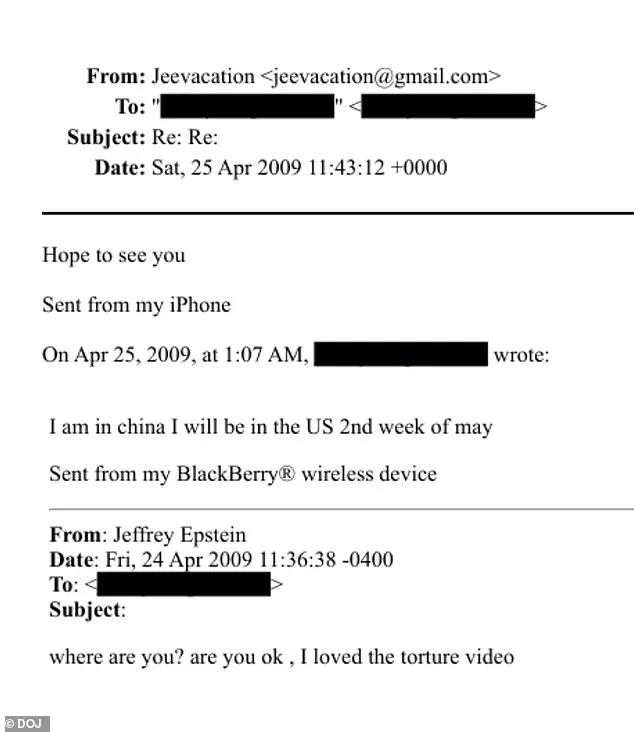
One of the earliest redacted emails in the files dates to April 24, 2009, when Epstein sent a message to an associate referencing a 'torture video.' The associate, whose identity is obscured, responded from a BlackBerry, stating they were in China and would return to the U.S. in early May. Epstein's reply—'Hope to see you'—suggests a level of familiarity that has led Massie to speculate the sender may have been a 'sultan' or a foreign dignitary. The email, however, remains devoid of context about the nature of the 'torture video' or the identity of the associate.
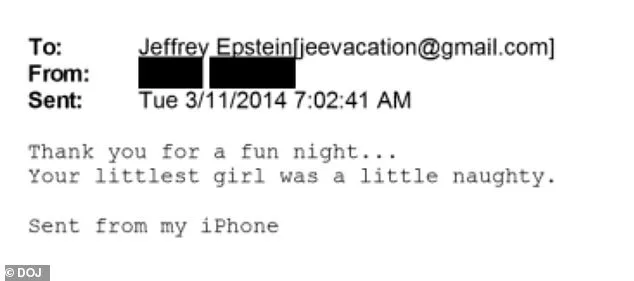
Another troubling email, dated March 11, 2014, features a sender who wrote to Epstein: 'Thank you for a fun night… Your littlest girl was a little naughty.' The message was sent from an iPhone to Epstein's personal email account, [email protected]. The sender's name is entirely redacted, leaving only a pair of black bars in its place. This email was sent six years after Epstein was jailed for procuring a minor for prostitution, a sentence that was later reduced to 13 months through a plea deal in 2008. Social media users have demanded that the identity of the sender be revealed, with one X user writing, 'America deserves to know who the f*** this person is.'
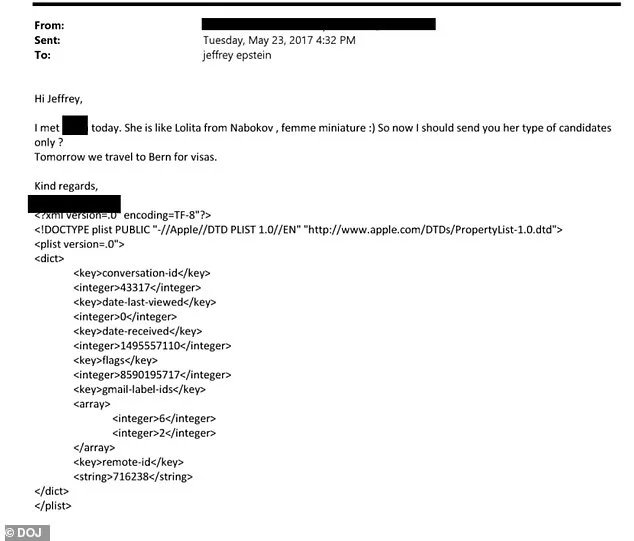
Other emails in the files reference young women in explicitly troubling terms. A 2017 message from a redacted sender described a girl as 'like Lolita from Nabokov, femme miniature,' suggesting a deliberate effort to draw parallels to literary depictions of underage girls. In 2018, another redacted email included a description of a 'sweet girl' and included a photograph, which Epstein responded to with 'looks like you.' These exchanges, while devoid of explicit details about the girls themselves, have been interpreted by some as evidence of Epstein's continued interest in exploiting minors even after his 2008 conviction.
The files also contain a draft indictment from 2000, prior to Epstein's 2008 plea deal. This document, spanning 56 pages, lists three individuals as co-conspirators in Epstein's alleged activities, though their names remain redacted. Additionally, a chart from the files shows Epstein and Ghislaine Maxwell, his longtime associate, but also includes four other redacted individuals—three employees and a 'girlfriend.' The chart notes that the 'girlfriend' was rumored to be Epstein's 'sex slave,' while one employee was described as having 'at least 10 girls state she is the direct point of contact for scheduling his massage appointments.'
In a March 2017 email, a redacted sender suggested a woman for a job, describing her as 'willing to do anything you ask her.' Another candidate was characterized as 'not very young but beautiful.' These messages, while seemingly innocuous in their wording, have been interpreted by critics as evidence of Epstein's network recruiting individuals for roles that may have facilitated his exploitation of minors. In a November 2015 email, Epstein wrote to a redacted associate: 'any friends for jeffrey while you are recovering?' The associate responded by mentioning a 'sweet girl' and included a photograph, which Epstein acknowledged with 'looks like you.'
The files also include a 2013 email from a Paris-based modeling agency, which described a 'New Brazilian just arrived, sexy and cute, 19yo.' A similar message from 2014 referenced a woman in a SpaceX shirt, while a 2015 email mentioned a 'beautiful little girl' with 'long soft blonde hair' spotted on Madison Avenue. These descriptions, though seemingly disconnected, have been analyzed by investigators as part of a broader pattern of Epstein's alleged predilections for exploiting young women, particularly those in modeling or entertainment industries.
Republican congressman Thomas Massie has been among the most vocal critics of the redactions, arguing that the Justice Department's failure to disclose names of individuals involved in Epstein's network is a betrayal of public trust. Democratic congressman Ro Khanna has echoed these sentiments, stating that the law was 'very clear' that redactions should not be used to conceal information unless it was classified. As the Epstein Files continue to be scrutinized, the debate over transparency and accountability shows no signs of abating, with lawmakers and the public demanding answers about the identities of those whose names were hidden behind the redactions.
Photos