Early Retirement May Double Risk Of Cognitive Decline For Workers

Millions dream of stepping away from the workforce early to escape stress in their later years, but a fresh report warns this move might backfire on your mind. Quitting your job before sixty-five could double the odds of slipping into cognitive decline for those who retire in their fifties. Researchers based in New York City spent sixteen years watching 2,400 Americans navigate careers and memory loss as they aged through their mid-fifties. The team dug deep into employment records and brain scans to see how work history shaped mental sharpness over time.
Women who left the labor force early faced nearly twice the risk of being diagnosed with mild cognitive impairment or dementia by the study's end compared to peers who kept working. Men saw a different pattern, where early retirement increased their chances of these conditions by exactly fifty percent relative to those staying in the workforce. In America, leaving work before age sixty-five counts as early retirement, though men usually clock off at sixty-five while women do so around sixty-three.
Why does holding onto a job seem to protect the brain? Experts point out that daily tasks force you to solve problems, juggle multiple jobs, make hard choices, and learn fresh procedures on the fly. This constant mental workout boosts neuroplasticity, giving your brain the power to adapt and forge new neural pathways even as it ages. Long stretches of unemployment or early exit from work linked directly to higher risks of cognitive impairment in women according to these findings.

Dr Erika Beidelman, who leads this research at Butler Columbia Aging Center in New York City, noted that employment instability hits men and women differently both in frequency and effect on the mind. She stated, 'Importantly, exposure to long-term employment instability differs systematically by gender in exposure, and likely in its impact on cognitive health.' Her team added that these gaps highlight why we must look at career paths through a gender lens to truly grasp late-life brain outcomes. Keep in mind this was an observational study, meaning it cannot prove early retirement caused the decline or dementia itself.
New research adds fuel to a growing concern that leaving the workforce too soon significantly raises the risk of cognitive decline. Roughly one out of ten Americans older than 45 already show signs of this trouble, ranging from blank stares when trying to recall names to getting lost while driving down familiar streets. Medical experts warn that between 10 and 15 percent of people with mild cognitive impairment will progress to full dementia every single year if left unchecked.
A fresh study just published in the journal Alzheimer's & Dementia examined 2,418 adults drawn from the Health and Retirement Study. These were long-term surveys focused on citizens over 65 who were roughly 57 years old when first recruited. The group was mostly female, with women making up 61 percent of the participants. Researchers dug into employment histories stretching back from 1998 all the way to 2014 while also administering tests in 2016 to measure memory, language skills, and executive function.
During repeated check-ins between those years, each person fit into one of seven categories based on their most frequent status across four visits. The groups included Employed-Job Secure, Employed-Job Insecure, Unemployed, Retired, Not in Labor Force, Self-Employed, and Unreported. Those flagged as job insecure were individuals who genuinely feared losing their positions within the next twelve months. Ultimately, 30 percent of women and 31 percent of men qualified for cognitive impairment labels like mild cognitive impairment or dementia.

Dr. Beidelman noted that embedding feelings of job insecurity into decades-long employment records offers a much clearer view of how work stress impacts the mind over time. The data revealed stark differences between genders regarding which jobs protected against memory loss. For women, almost every group except those with predominantly insecure jobs showed lower scores than peers who stayed in secure roles. Men followed a similar pattern where only self-employment offered protection against diagnosis compared to stable employment.
Why did job insecurity or self-employment actually show lower risks? Researchers suggest these demanding roles might keep brains sharp by forcing constant adaptation and problem solving. The charts clearly illustrate how early retirement and long spells of unemployment hit women hardest regarding cognitive scores. This information remains limited and privileged, yet the potential threat to entire communities is real. We must consider whether our current retirement culture might be accelerating a silent crisis in millions of households before it is too late.
Men who struggle to keep work steady end up scoring lower on cognitive tests. That link is clear in the new data. Beidelman put it plainly: keeping a job continuously seems to protect the brain far better than simply feeling secure about staying employed. It is not what you fear, it is where you actually stand.
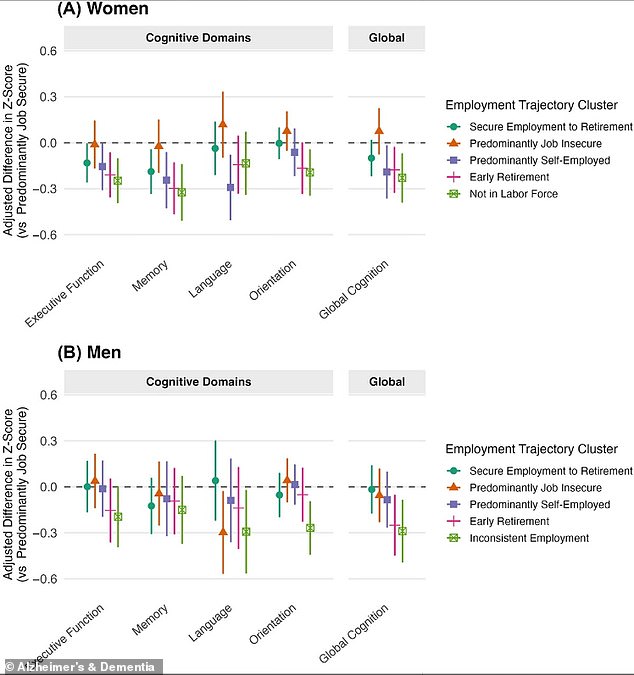
People who hung onto their jobs for years despite constantly worrying they would be fired did not see those same dips in scores. They held firm while others left the workforce entirely. That difference matters a lot. The experts believe steady work builds better brain connections. It pulls people into social circles and knocks down stress caused by fearing unemployment. This mix of activity, connection, and reduced worry keeps cognition sharp and fights harmful inflammation inside the skull.
The study has limits. Researchers did not sort out specific jobs that might be physically or mentally draining. Earlier work already warned us that high stress on the job can raise dementia risks. Beidelman noted this gap clearly. The findings still point to one big truth: holding a midlife position could change brain health decades down the road.
This factor is something we can actually fix. Policies that stop forced job jumps and keep workers attached to the labor force make sense here. Expanding access to work that challenges the mind during middle years could help people age without losing their mental edge. Public health officials need to look at this now. The window for action is open but closing fast if we ignore it.
Photos