Deadly Tetanus Cases Resurge Across US, Prompting Urgent Medical Warnings

A deadly illness that has plagued humanity for centuries is making a dangerous comeback across the United States, prompting urgent warnings from medical experts. Tetanus, a life-threatening condition that demands intensive care and often results in prolonged hospitalization, is currently experiencing a resurgence. This bacterium, Clostridium tetani, exists naturally in the environment and enters the body through wounds, releasing a potent toxin that disrupts neurotransmitter release.
The resulting muscle contractions and uncontrolled spasms define the disease's terrifying progression. Early symptoms often include lockjaw, a painful inability to open the mouth. As the infection spreads, severe body-wide spasms can trigger respiratory failure by seizing the chest wall, paralyzing the diaphragm, and blocking the airway. Additional complications frequently involve nervous system dysfunction, skyrocketing blood pressure, and irregular heart rhythms. Consequently, approximately one in ten infected individuals succumbs to the disease.

Provisional data for 2025 reveals a troubling trend: 38 reported cases. This figure surpasses the 33 cases recorded in 2024 and marks the highest count since 2026, when 41 cases were documented. Such statistics alarm doctors who see a clear upward trajectory. Writing in the journal JAMA, two pediatricians highlighted that four pediatric cases within a single year was a "striking" development. Tetanus predominantly affects the elderly, many of whom missed childhood vaccinations because the shot was not yet recommended during their youth.
The situation grows even more alarming when families reject life-saving interventions. The pediatricians noted that in two of the four child cases, parents refused both treatment and the prophylactic vaccine following injuries. They stated, "Both the lack of appreciation of the tetanus-prone wound status and the inadequate implementation of recommended post-exposure tetanus prophylaxis due to incomplete clinician care or refusal of receipt by the patient or parent are extremely concerning." According to CDC reports, none of the four children, who ranged in age from one to 15, had received tetanus vaccinations.
Across the board, treatment remains inconsistent among those seeking care. Medical records indicate that doctors administered tetanus treatment only two percent of the time and provided the vaccine just 26 percent of the time when medically indicated. The experts emphasized that recent data underscores the severity of the threat, noting that nearly every case requires hospitalization. Many patients need mechanical ventilation and tracheostomy tubes to sustain their lives until recovery becomes possible.
Crucially, tetanus does not spread from person to person, meaning herd immunity offers no defense. Prevention relies entirely on vaccination, most commonly the Tdap shot, which also guards against diphtheria and pertussis. While the Tdap vaccine became standard in 1948, children under seven receive the DTaP formulation, which provides similar protection in a different format. The natural presence of the Clostridium tetani bacterium means that vigilance and vaccination remain the only lines of defense against this ancient killer.
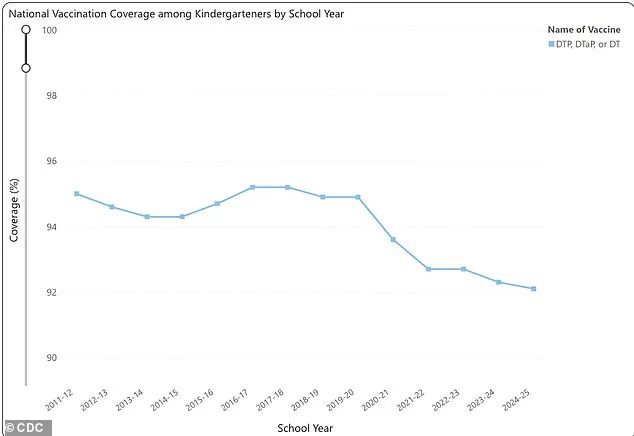
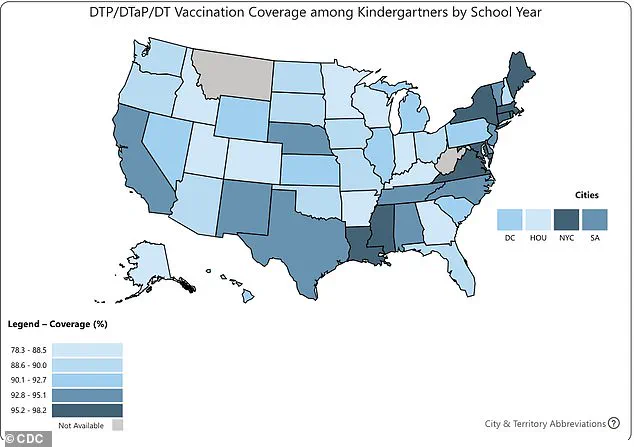
Upon entering the human body, typically via a breach in the skin, the bacterium releases a potent toxin that triggers tetanus. The accompanying chart illustrates the national immunization coverage rates for tetanus among kindergarteners preparing for the 2024-2025 academic year.
The standard immunization schedule involves a five-dose series administered as injections at two, four, and six months, followed by additional doses between 12 to 18 months and again between four to six years of age. Subsequently, a Tdap booster is advised between 11 and 12 years old. Following this, individuals should receive a booster every decade, or sooner—within five years—if they sustain a severe, dirty wound or a burn. Pregnant women are also urged to receive the Tdap shot during their third trimester in every pregnancy to safeguard their newborns against infection.
Despite the vaccine's proven safety and efficacy, a growing tide of skepticism and hesitation has led to a noticeable drop in tetanus immunizations. The Centers for Disease Control and Prevention (CDC) documented a decline in DTaP vaccination rates among kindergarteners to 92 percent for the 2024-2025 school year. This downward trend began in the 2019-2020 academic year, when coverage stood at 95 percent. Pediatricians have expressed deep concern over these falling primary immunization rates and the insufficient vaccination of pregnant women, which leaves infants vulnerable to preventable diseases.

The Tdap vaccine, which has been in widespread use since the 1940s, remains a critical tool for preventing infection and death. CDC data indicates that tetanus-related mortality has dropped by more than 99 percent since the early 1900s, coinciding with the adoption of first-line treatments, and has stabilized at approximately two deaths annually since 2000. Since the disease became a reportable condition in 1947, overall incidence has plummeted by 99 percent.
A recent CDC analysis revealed that between 2009 and 2023, the United States experienced 402 tetanus cases resulting in 37 fatalities. Of the patients with a known vaccination history, 44 percent had received no prior tetanus shots, underscoring significant gaps in coverage. Another 33 percent had received only one or two doses, while 23 percent had received three or more. Furthermore, among those who had received at least one Tdap dose, 59 percent had their last injection more than a decade before contracting the disease.
Medical professionals analyzing CDC data for JAMA highlighted these findings, noting, "Although the report affirmed the remarkable effectiveness of the tetanus vaccine, it raised several concerns, particularly because the value of all vaccines is increasingly being questioned." They pointed out that since the onset of the pandemic, vaccination rates have fallen, especially among children eligible for the Vaccines for Children program, while the proportion of children with vaccine exemptions has risen.
Tetanus remains a terrifying illness capable of causing immense suffering and, in some instances, death. The medical community emphasizes that vaccination and maintaining a high index of suspicion for tetanus are paramount. Clinicians bear the responsibility of engaging parents and patients with empathy, confronting misinformation head-on, and championing accessible, culturally sensitive immunization initiatives. With decades of experience supporting the vaccine's safety and efficacy, the medical field urges that if vaccine hesitancy continues to grow and mandatory school entry requirements are relaxed, an increase in vaccine-preventable diseases, including tetanus, is inevitable.
Photos