Dana Mosunic's Missed Warning Signs Led To Delayed Diagnosis

It started so quietly that Dana Mosunic missed it entirely when her right hand began to shake just enough to ripple a glass of water. Her twenty-three-year-old daughter, Caitlin, was the one who spotted the tremor first. Dana, then forty, brushed it off as nerve damage from recent shoulder surgery. She did not listen.
Months later in 2017, another oddity surfaced while she took a walk. Looking down at her shadow revealed that one arm refused to swing naturally by her side. Her right foot started dragging along the pavement. When behind the wheel of her car, the hamstring in that same leg would tighten without warning. None of these signs felt dangerous on their own. Dana, a mother of two, simply assumed she was aging or becoming clumsy. She kept going as usual for years.
The truth arrived in June 2023. Her primary care physician finally sent her to a neurologist for a specialist brain scan. Dana expected to wait weeks at home for results. Instead, the doctor called before she left the hours-long appointment. The images showed exactly why she had felt so strange for so long. At forty-five years old, Dana Mosunic had Parkinson's disease.

The diagnosis landed during what should have been a bright new chapter in her life. She planned to marry Eric, a police officer and partner of nearly ten years, within three months. Her two daughters were off at college, busy building lives of their own. Suddenly, she faced a progressive brain disease with no cure. It was hard to swallow. Dana told the Daily Mail that she felt healthy yet terrified by so many unknowns. She still struggles to fully accept it today.
Parkinson's develops when cells in a small brain region called the substantia nigra begin to die. These specific cells produce dopamine, a chemical messenger vital for coordinating smooth and controlled movement. As dopamine levels drop, hallmark symptoms appear including tremors, muscle stiffness, and increasingly slow or difficult motion. People normally lose some dopamine-producing cells as they age. But in Parkinson's, that destruction happens far more rapidly. Symptoms typically do not emerge until around fifty to sixty percent of those cells have already been lost.

More than ninety thousand Americans are now diagnosed with Parkinson's every year. That number represents about fifty percent more cases than previously estimated. By 2030, roughly one point two million people are expected to live with the disease. Age remains the biggest risk factor, with most patients receiving a diagnosis after turning sixty. The explosion of this condition among young adults suggests a troubling shift that scientists fear they might understand but cannot yet fix.
Genetics play a role for roughly ten to 20 percent of patients who have a family history of the disease. Yet Dana belongs to a troubling group that experts are increasingly concerned about: people developing Parkinson's in their 40s and 50s, often with no obvious genetic explanation. Scientists increasingly suspect that, for at least some of them, the seeds of the disease may have been sown decades earlier. While there is no single proven cause, mounting research has linked Parkinson's to environmental hazards encountered in everyday life – including pesticides and air pollution. The troubling part is that many of these exposures can be difficult to avoid – and the damage may begin years, or even decades, before the first tell-tale tremor appears.
"You're always kind of curious as to, was it chemicals or was I near pollution?" Dana asked herself. "Did it have something to do with all the popcorn ceilings in elementary school when I was a kid in the 80s? You really just have zero idea, and there's no way to figure that out. It's frustrating." The uncertainty has also left Dana worrying about her daughters, Caitlin, 23, and Hailey, 20, and whether they too could one day develop the disease. "You want to protect your kids," she said. "I feel bad because they're going to watch me go through this, and I don't want them to be concerned that this is going to be their future too."
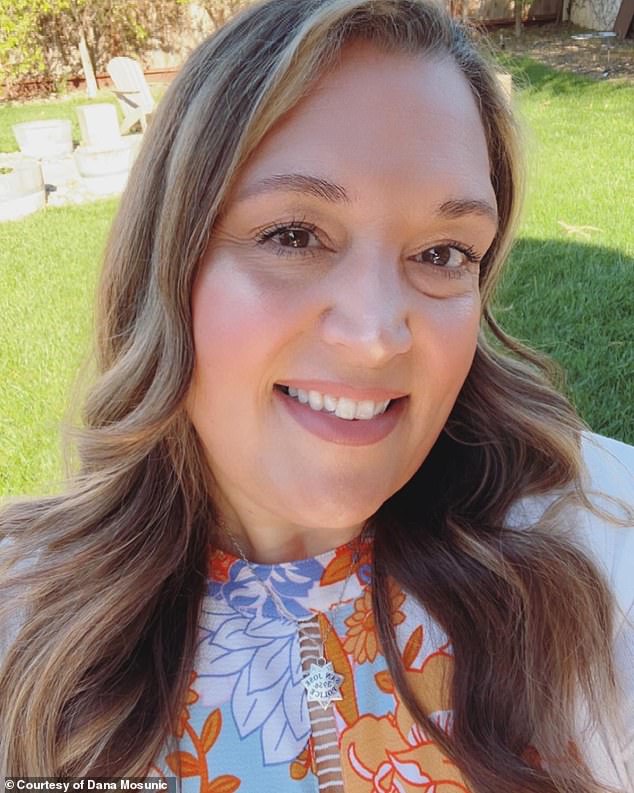
Dana, pictured above, suffered from tremors, stiffness and foot dragging on the right side of her body, prompting her diagnosis. Just three months after her diagnosis, she married Eric in a small, intimate ceremony in Lake Tahoe. "It did kind of suck to go into the wedding with that knowledge because the last thing you ever want is to feel like a burden on your partner," she said. "But it was one of those things where I thought, 'I'm going to deal with this after.' Once the celebrations were over, that became much harder to do." Dana wanted to know what came next. Could she do anything to slow the disease? How long would it be before it affected both sides of her body – or began to rob her of her ability to walk, talk and carry out everyday tasks independently? But there were few concrete answers.
Unlike many other serious diseases, Parkinson's has no predictable course. Some patients deteriorate relatively quickly, while others continue living independently for decades. And while drugs can control symptoms, there is currently no treatment proven to stop the underlying disease from progressing. "One of the things I've learned over the past three-plus years is that no one experiences this disease the same way, and we all progress very differently," Dana said. "You don't really have a roadmap. It's a lot of talking to doctors and doing your own research." So far, Dana's physical symptoms have remained largely confined to the right side of her body, where she experiences tremors and stiffness. But some of the symptoms she finds most difficult are invisible. She suffers bouts of brain fog and, most troublingly, apathy – an overwhelming lack of motivation that she had no idea could be caused by Parkinson's. For Dana, something as simple as putting on a load of laundry can suddenly feel as though it requires more effort than it is worth. "Apathy was probably my worst one, but I had no idea Parkinson's was linked to apathy," she said. "That one just caught me off guard." Dopamine does far more than control movement.
The disease strikes at motivation itself by dismantling the brain's reward circuitry, leaving even simple chores feeling like mountains when dopamine-producing cells vanish. Dana now relies on antidepressants to stabilize her mood while taking a specific combo of levodopa and carbidopa to refill her depleted dopamine stores. Levodopa transforms into dopamine once it crosses the blood-brain barrier to stop tremors and stiffness, whereas carbidopa blocks premature breakdown before the drug reaches its target. She walks daily and hits the gym hard to keep her strength and balance intact because research shows movement preserves mobility and eases disease-related motor issues. Doctors suggest mixing aerobic activity like brisk walking or cycling with strength training and agility drills that specifically challenge balance.
'This is such a long road ahead,' Dana said as she faces the diagnosis one day at a time while connecting with other young patients who changed her perspective. Since finding out what was wrong, she has documented life with early-onset Parkinson's on TikTok where she found a community of others facing this disease decades earlier than expected. She initially feared public discussion would let the illness define her identity, yet hearing from peers in the same boat made her feel less isolated instead. 'It's a scary time to get a diagnosis like that because a lot of us have younger families,' she said. 'A lot of us are in the middle of our careers. It's kind of a weird place to be, and it can be really scary.' Listening to other people share their stories has helped her gain insight, proving that more voices talking about this condition brings benefits for everyone involved.
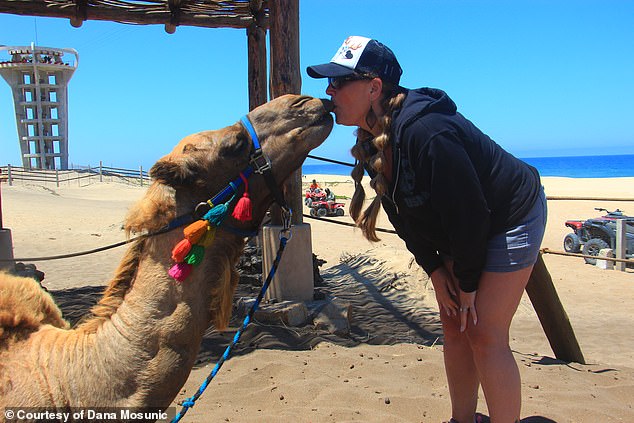
Dana is increasingly determined to make the most of what she can still do while Eric takes regular trips to Disneyland with her daughters and his two sons, ages 20 and 16. These days matter all the more because she can currently walk around the park with little assistance before that ability fades completely. It is an attitude she encourages other younger patients to adopt immediately rather than waiting for mobility to disappear entirely. 'Don't let it steal the things that you enjoy doing,' she said. 'There are always adjustments you can make to continue doing the things you love, and it's so important to keep those things in your daily life.' She spends time building support systems by reaching out to people dealing with the same thing because it helps individuals feel seen and understood. Do whatever you can not to let it steal your joy in life.
Photos