Can You Match These Shades in 10 Seconds? The 'Hue Shift' Test Exposes Hidden Truths About Color Perception

How good is YOUR colour perception? A new deceptively difficult test challenges you to match two shades within 10 seconds — and it might just expose how little you truly know about the world of hues.
Most of us take colour for granted, learning to distinguish between red and blue as toddlers. But this test, called "Hue Shift," will make you question everything. The game presents two colours: one is fixed, the other yours to adjust. The goal? Match them by dragging sliders to shift hue and lightness until they align. Sounds simple? Think again. With only 10 seconds per round, the pressure is on — and the difficulty is far greater than it appears.
"Two colours. One is fixed. The other is yours to bend," the game instructs. "Drag to shift hue and lightness until they match." Each round shows two blocks on your screen. All you must do is adjust the right one to match the left — but the clock ticks relentlessly. A countdown from 3 warns you when time is nearly up, forcing quick decisions. After each attempt, you're told how close you were — and your final score, measured in delta-E, reveals just how sharp your colour vision really is. The lower the number, the better.
The game's creator, software engineer Keith Cirkel, designed "Hue Shift" to highlight the intricacies of human perception. His website features a range of colour-based challenges, each aimed at testing and improving visual acuity. To play, simply click the "Let's go" button — and brace yourself for the test. The interface is intuitive, with a palette at the top guiding your choices. But the real challenge lies in the speed: even seasoned players find themselves struggling under the time limit.
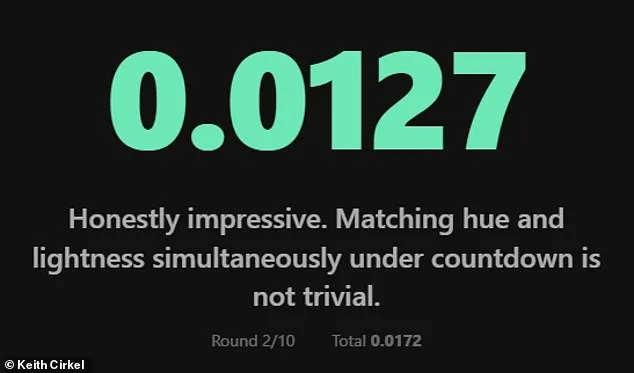
Feedback from users tells a story of frustration and progress. If you score low, a message pops up: "The drag controls take a round or two to click. Once that's in your fingers, the scores drop fast. Worth another go." But if you excel, the game rewards you with praise like: "Consistent and controlled. You understood early that horizontal is hue and vertical is lightness, and you didn't fight the axes." It's a subtle but powerful reminder of how much practice and strategy can shape performance.
The test isn't just fun — it's educational. Delta-E scores, a standard in colour science, quantify the difference between two colours. Lower scores mean your eyes are picking up on minute variations — a skill that has real-world applications, from graphic design to quality control in manufacturing. Yet for most, the revelation is humbling: even the best colourists can be tripped up by time constraints and the subtleties of lightness versus hue.
If "Hue Shift" isn't enough, Cirkel has another gem: "What's My JND?" This viral sensation tasks players with finding the line between two colours — a task that starts easy but quickly becomes maddeningly hard. The game's instructions are deceptively simple: "You see two colours. Click on the line between them. That's it." But as the rounds progress, the colours grow ever closer until you're forced to confront your Just Noticeable Difference — the smallest change your eyes can detect.
Both games are more than just entertainment. They're windows into the complexity of human perception, revealing how easily we underestimate our own abilities. Whether you're a professional designer or a curious beginner, these tests offer a unique blend of challenge and insight. And with each round, they remind us: seeing is believing — but sometimes, believing is the hardest part.
Photos