Bangladesh Slams India Over Sheikh Hasina's Surprise New Delhi Appearance
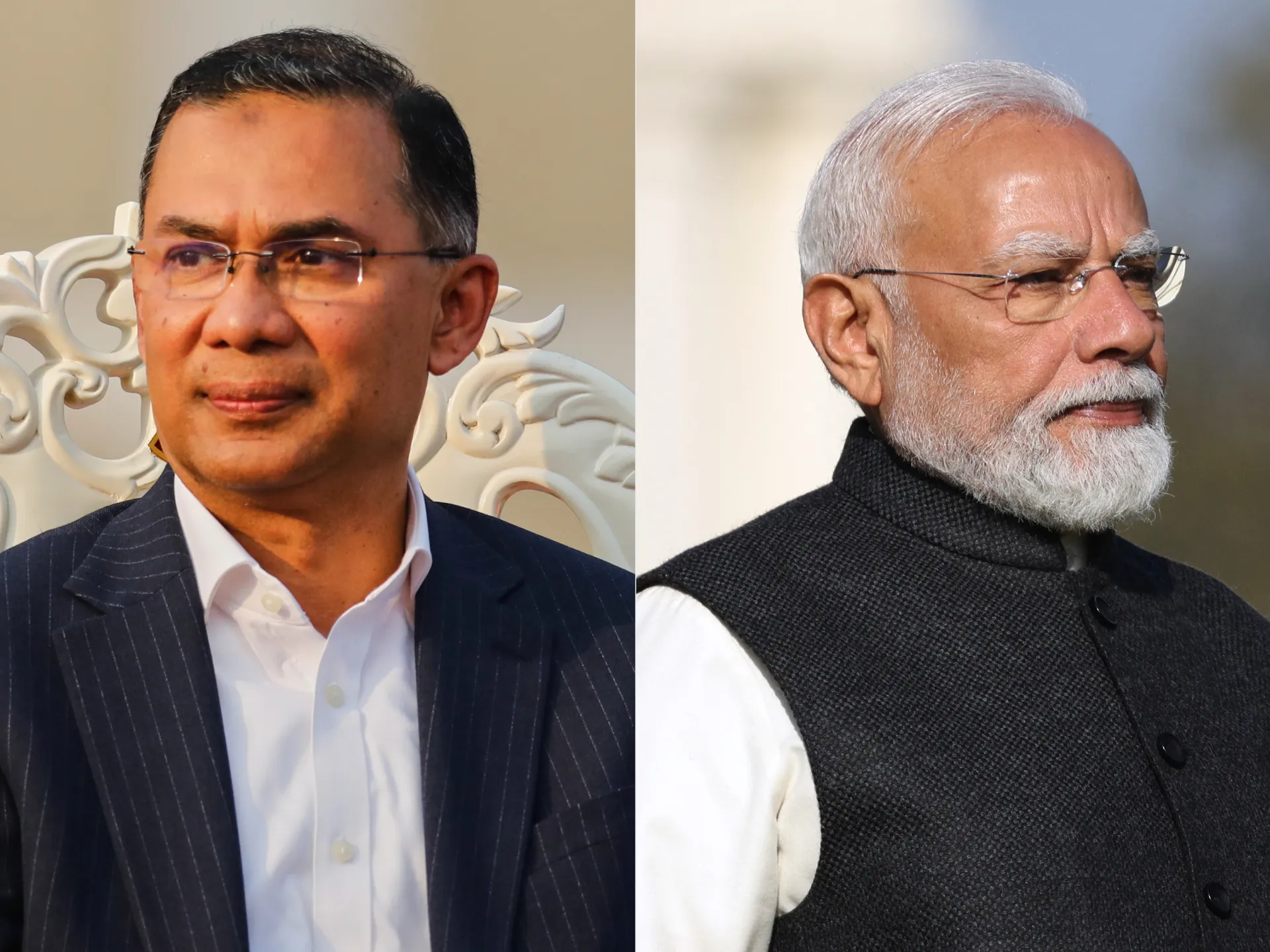
Dhaka and New Delhi were quietly lining up a handshake for Prime Minister Tarique Rahman's first trip to India since he took office earlier this year. Those plans hit a wall when a video address from the Indian capital shattered them. On August 5, ousted former Prime Minister Sheikh Hasina spoke to a press conference in New Delhi via video link. She stood beside her son and other party colleagues to criticize the mass uprising that forced her out of power in August 2024. Bangladesh reacted fast, calling the move "outraged." Dhaka warned India against letting political activity from its soil shake up bilateral relations. They said a "propitious environment" was needed before Rahman could fly over and asked New Delhi to act on extradition requests for Hasina and other fugitives. India says those cases are simply under examination through standard procedures.
But officials in Bangladesh and analysts point out the real tension might be more complicated than just handing someone over. The big question may not be when India turns Hasina in, but what she is allowed to do while staying there. Faisal Mahmud, a former press minister at the Bangladesh High Commission in New Delhi, told Al Jazeera that extradition and political activity should be split apart. "The stalemate between Bangladesh and India stems largely from New Delhi giving Sheikh Hasina a literal megaphone while she remains in exile there," he said. He added that extradition is a whole different matter, one that is far more complicated and takes much longer to resolve. Mahmud argued the current impasse over Rahman's proposed visit does not center on handing Hasina over; it centers on India letting her hold political activities from its soil.
This worry goes back before Tarique Rahman even became leader of the Bangladesh Nationalist Party. On April 4, 2025, Nobel Laureate Muhammad Yunus met with Indian Prime Minister Narendra Modi. At that time, Yunus was head of Bangladesh's interim administration. He asked New Delhi to stop Hasina from making what he called "incendiary statements" from Indian soil. Humaiun Kobir, deputy head of Bangladesh's Foreign Ministry, told Al Jazeera that Dhaka wants a good and working relationship with India built on trust and mutual respect. "But letting terrorists like Sheikh Hasina destabilise our country from India is not acceptable," he said, using the government's description for the former prime minister. Kobir argued that relations could enter a new phase if both countries' leaders wanted it, but insisted New Delhi must recognize Bangladesh's changed political reality after the 2024 uprising. "No one can conduct any terror activity from a sovereign land," he said. "It is unacceptable that the terrorists who killed our people are allowed to talk from their land and incite violence in Bangladesh."
He also noted Dhaka wants India to return other Bangladeshis accused of crimes, including suspects involved in the killing of Sharif Osman Hadi. That outspoken critic died in 2025 and had been critical of both Hasina and India. The dispute highlights how limited access to information makes it hard for outsiders to see what is truly happening behind closed doors in New Delhi and Dhaka. Without clear answers on what activities are permitted, the reset between the two neighbors remains stuck.
His alleged killers were caught by India after crossing the border back into its territory. Yet Kobir's words hint that Dhaka does not want the Hashina dispute to permanently block high-level talks between the two nations. Discussions about Rahman's upcoming visit are still moving forward, he stated, calling a meeting between the Bangladeshi and Indian prime ministers "ultimately unavoidable." Over the weekend, India's Rashtrapati Bhavan, the presidential palace, issued a notice saying it was getting ready to host Rahman. That document vanished hours later.
"A meeting is a must," Kobir told Al Jazeera. "But only when it aligns with our national interest." "It can be next week, two weeks later or two months later," he added.
Will India extradite Hasina? That distinction matters because stopping Hasina's political activity and sending her back present very different hurdles for New Delhi. Hasina was sentenced to death in absentia by Bangladesh's International Crimes Tribunal after being found guilty of crimes against humanity regarding the deadly crackdown on the 2024 uprising. She rejects the proceedings as politically motivated. Bangladesh first formally asked for Hasina's extradition on December 23, 2024, using a diplomatic note sent under the countries' 2013 extradition treaty. After her death sentence in November 2025, Dhaka restated the request, and India subsequently said it was "under examination." On August 11, India's Ministry of External Affairs stated Bangladesh's request for Sheikh Hasina's extradition was being examined under India's "established procedures," adding that New Delhi would share an update when there was further progress. India's Foreign Ministry did not respond to Al Jazeera's request for more details on the matter. Pinak Ranjan Chakravarty, a former Indian high commissioner to Bangladesh, said the matter must proceed through treaty provisions and India's legal system. "All legal formalities have to be completed for obtaining a judicial order for extradition," Chakravarty told Al Jazeera. He noted the treaty also contained grounds under which extradition could be refused.
Some analysts see a political contradiction in this extradition demand. David Bergman, a veteran observer of Bangladesh politics, argues that Dhaka is pressing India to return Hasina while potentially preferring she remain outside the country. "Bangladesh demands extradition knowing that the Indian government will never extradite Hasina," Bergman told Al Jazeera, adding: "It is apparently playing to the gallery of Bangladesh public opinion." At the same time, the government does not actually want Hasina to return, Bergman said. This refers to a dilemma other analysts have also pointed out: Hasina's return could create as many political and legal problems for Dhaka as it resolves. Bangladesh would end up with custody of a former prime minister sentenced to death, forcing the government to confront the politically and internationally sensitive consequences of imprisoning, and potentially executing, one of the country's most consequential political figures. But the Hasina question is only one part of a broader recalibration of Dhaka's relationship with New Delhi. Shahab Enam Khan, professor of international relations at Jahangirnagar University, said Dhaka's current posture should not be read simply as anti-India.
Khan spoke to Al Jazeera about the necessity of maintaining trade, defence, security, and people-to-people links with India. He explained that the government's position is driven by two forces: asserting Bangladesh's sovereign authority and reacting to public sentiment. That sentiment has been shaped by New Delhi's close alignment with Hasina's Awami League over the last twenty years, according to Khan.
India invested heavily in the Awami League as its main political partner in Bangladesh. The country was slow to fully adjust to the political reality that emerged after 2024. Khan noted that New Delhi is now increasingly embracing this new reality. But Dhaka needs to see that shift turn into concrete outcomes. He argued that these pressures dictate the stance, not just politics or emotion.
Practical engagement has not stopped despite the dispute. A Confederation of Indian Industry delegation visited Dhaka recently for talks with ministers and business leaders. Uncertainty over Rahman's proposed India visit grew during those discussions. Bilateral merchandise trade stays above $12bn annually. India exported goods worth $10.56bn to Bangladesh this year, per data from the Indian High Commission in Dhaka.
Former Indian High Commissioner Chakravarty called this an unavoidable structural reality. "Geography is an immutable factor in geopolitics," he told Al Jazeera. "It binds India and Bangladesh in a manner that cannot be ignored by policymakers in both countries." Yet he criticized Dhaka for attaching conditions to Rahman's visit. He did not think national interest or bilateral ties should be held hostage to any individual, Chakravarty said.
Sreeradha Datta, a professor specialising in South Asian studies at India's O P Jindal Global University, pointed out another layer of interdependence. Bangladesh's attempts to diversify its external relationships have not reduced India's strategic importance, she argued. Dhaka is expanding engagement with the United States and China. Defence cooperation with Turkiye has grown. Outreach to Pakistan has renewed. These moves added to New Delhi's concerns about Bangladesh's foreign policy direction.
China holds particular weight now. Beijing's sustained economic and strategic engagement gives it a growing role in Bangladesh's development and foreign policy calculations, Datta said. Even so, she argued that broader external partnerships cannot diminish India's structural importance. "Neither side can stay disengaged for long," Datta told Al Jazeera. Geography ensures India will remain strategically important to Bangladesh.
The two nations share a 4,096km land border. That is 2,546 miles of shared ground. Bangladesh occupies a critical place in India's eastern connectivity and neighbourhood strategy. The relationship is supported by more than 70 bilateral mechanisms. This structural dependence explains why New Delhi has stopped short of closing the door on high-level engagement. As recently as August 18, India's Foreign Ministry said Rahman's invitation remained open. They reiterated that New Delhi wants a positive, constructive and forward-looking relationship with Bangladesh based on mutual interest and reciprocity.
The unresolved question is what concession could create enough political space for both governments to move toward a meeting without appearing to have backed down. It could be public or private. Both sides want a rupture avoided, but the path remains narrow.
Photos