AMOC Collapse Could Unleash Deep Ocean Carbon, Amplifying Global Warming Despite Cooling

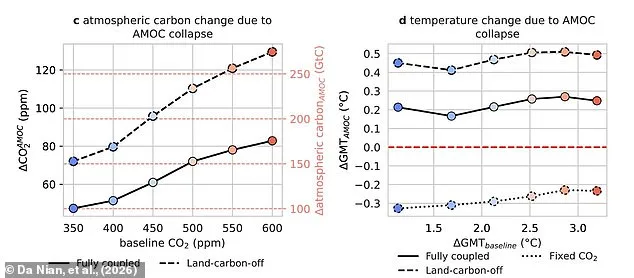
A groundbreaking study has unveiled a chilling scenario: the potential collapse of the Atlantic Meridional Overturning Circulation (AMOC), a vast ocean current system that includes the Gulf Stream, could unleash a "substantial" release of carbon dioxide from the deep ocean. This, scientists warn, might paradoxically amplify global warming even as it cools parts of the planet. The Potsdam Institute for Climate Impact Research's simulations reveal that if this critical current were to fail, carbon trapped in the ocean's depths could flood into the atmosphere, raising global temperatures by up to 0.27°C (0.5°F). This revelation challenges earlier predictions that an AMOC collapse would plunge Europe into a new Ice Age, instead suggesting a more complex and alarming climate disruption.
The AMOC operates like a colossal conveyor belt, moving water and heat across the globe. At its core is the sinking of cold, salty water near Greenland, where freezing conditions cause seawater to become denser and sink, pulling warm water northward. This process, however, is under threat. As glaciers melt and freshwater pours into the North Atlantic, the water's density decreases, slowing the current. Previous research has highlighted the AMOC's precarious state, teetering on the edge of a tipping point. But the new study introduces a previously overlooked consequence: the release of vast carbon reserves locked in the deep ocean.
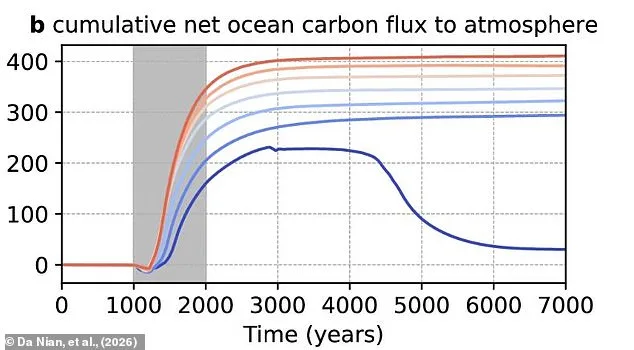
"Until now, we've focused on how AMOC collapse might cool the Northern Hemisphere," says Johan Rockström, director of the Potsdam Institute. "But we've underestimated how this event could flip the Southern Ocean from a carbon sink to a carbon source, unleashing stored CO2 and accelerating global warming." The simulations, which modeled the AMOC under varying CO2 concentrations and freshwater inputs, consistently showed a surge in atmospheric CO2 following the current's failure. This occurs because disrupted ocean mixing brings carbon-rich deep waters to the surface, where they can escape into the atmosphere.
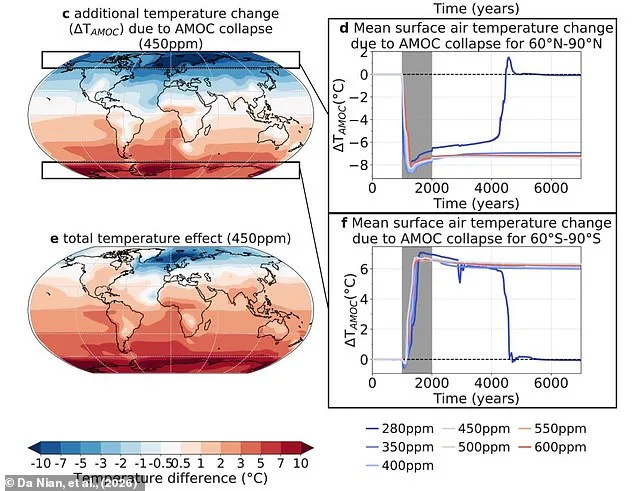
The implications are stark. While Europe and parts of the Northern Hemisphere would experience a dramatic cooling—up to 7°C (12.6°F) in Antarctica—the Southern Hemisphere and the Arctic could face extreme warming. The Arctic, in particular, would see temperatures rise by 6°C (10.8°F), compounding the effects of climate change. "The more CO2 already in the atmosphere when AMOC collapses, the worse the consequences," explains co-author Dr. Matteo Willeit. His team found that even at pre-industrial CO2 levels (around 280 parts per million), the AMOC could fail, but the damage would worsen as concentrations rise. At current levels (420 ppm), the collapse would release significantly more carbon, and at 450 ppm, Antarctic temperatures could soar by over 10°C (18°F).
This dual crisis—cooling in the north and intensified warming in the south—reveals the AMOC's collapse as a catastrophic domino effect. It not only disrupts weather patterns but also undermines the ocean's role as a carbon buffer. "The ocean has been our greatest ally, absorbing a quarter of human-made CO2 emissions," Rockström emphasizes. "But if the AMOC fails, that ally could become our enemy." The study underscores the urgency of limiting CO2 emissions, as even modest increases in atmospheric concentrations could lock in irreversible changes. For now, the AMOC remains vulnerable, its fate hanging in the balance as glaciers melt and the climate spirals toward an uncertain future.
The world's ice sheets are teetering on the edge of irreversible collapse, with cascading consequences for coastal regions and global ecosystems. Scientists warn that the accelerating melt of Antarctica's Thwaites Glacier—a critical linchpin holding back vast ice reserves—could unleash a surge in sea levels that would submerge millions of homes and redraw coastlines. Recent models suggest that if the glacier's destabilization continues unchecked, global oceans could rise by nearly 65 centimeters, a figure that would dwarf the impacts of previous climate projections.
The situation is compounded by the weakening of the Atlantic Meridional Overturning Circulation (AMOC), a vast ocean current that regulates temperatures across the globe. Evidence now points to a dangerous feedback loop: rising CO2 levels are not only warming the planet but also altering the AMOC's delicate balance. At concentrations above 350 parts per million, a threshold already surpassed decades ago, the system becomes increasingly prone to collapse. Current levels of 420 parts per million have pushed the AMOC into a precarious state, where even a minor disruption could trigger a permanent shutdown.
Dr. Willeit's research underscores the grim reality: once the AMOC collapses, recovery is not just unlikely—it is impossible. The current's weakening has already begun to shift weather patterns, intensify storms, and disrupt marine life. If the system fails entirely, the consequences would be felt for centuries. Warmer waters in the North Atlantic could freeze over, while tropical regions face prolonged droughts. The collapse would not be a sudden event but a slow, grinding process, with the AMOC's strength dwindling over generations before vanishing entirely.
Time is running out for policymakers and scientists to act. The window for stabilizing CO2 levels has narrowed dramatically, and every additional ton of emissions increases the likelihood of a point-of-no-return scenario. With glaciers like Thwaites already losing ice at an alarming rate, the urgency of the moment cannot be overstated. The coming decades may determine whether the world avoids catastrophe or locks itself into a future of rising seas and unruly climate chaos.
Efforts to monitor these systems are intensifying, but the data paints a clear picture: the planet is nearing tipping points that could reshape the Earth for millennia. Without immediate and drastic reductions in emissions, the warnings from Thwaites and the AMOC may soon become the grim headlines of a new era.
Photos